A decade into the ‘Smart Cities’ initiative, which sought to reshape urban India across 100 cities through projects worth over ₹1.6 lakh crore, the country has already begun the journey towards smarter and more integrated urban development; the next step must now be to build cities that are financially self-sustaining, institutionally coordinated and execution ready.The need of the hour is to build cities in which urban local bodies, development authorities, transport agencies, pollution control boards, housing boards, revenue and land departments etc. work in close coordination rather than in silos, enabling the development of building a truly integrated, livable city.
The issue arises when transport building plans are not integrated with land-use plans, drainage and flood management are handled separately from road development, housing projects are not linked to mobility and employment nodes etc. Bengaluru offers a telling example of the costs of such fragmented planning, where road-building, land-use expansion and storm-water management have too often progressed in silos rather than as part of an integrated urban strategy.A city that has expanded rapidly as one of India’s largest employment magnets, the costs of fragmented planning become even sharper when migration-led growth places additional pressure on already strained roads, drains and civic infrastructure.
Urban planning must thus, move beyond short-term, reactive responses and be anchored in projected migration flows, future land-use requirements, and the long-term capacity needs of mobility, drainage and public service infrastructure.It is in this context that initiatives such as the vision of a 30-minute NCR acquire even more significance: an endeavor to shift from fragmented urban development towards an integrated planning framework where transport connectivity, housing solutions, employment nodes and supporting robust infrastructure are conceived as a part and parcel of a single housing strategy.
However, while the framework for a 30-minute NCR transit network has been established, the focus must now shift to on-ground execution, supported by a robust and bankable project pipeline.
The next pertinent question being: Can the nation move from scheme-led urban development to bankable reform-linked, execution oriented urban development. Can the long-standing bottleneck of raising market finance, strengthening balance sheets of municipal corporations, encouraging them to raise funds through municipal bonds, reforming land and governance systems and delivering integrated development at scale now be addressed.
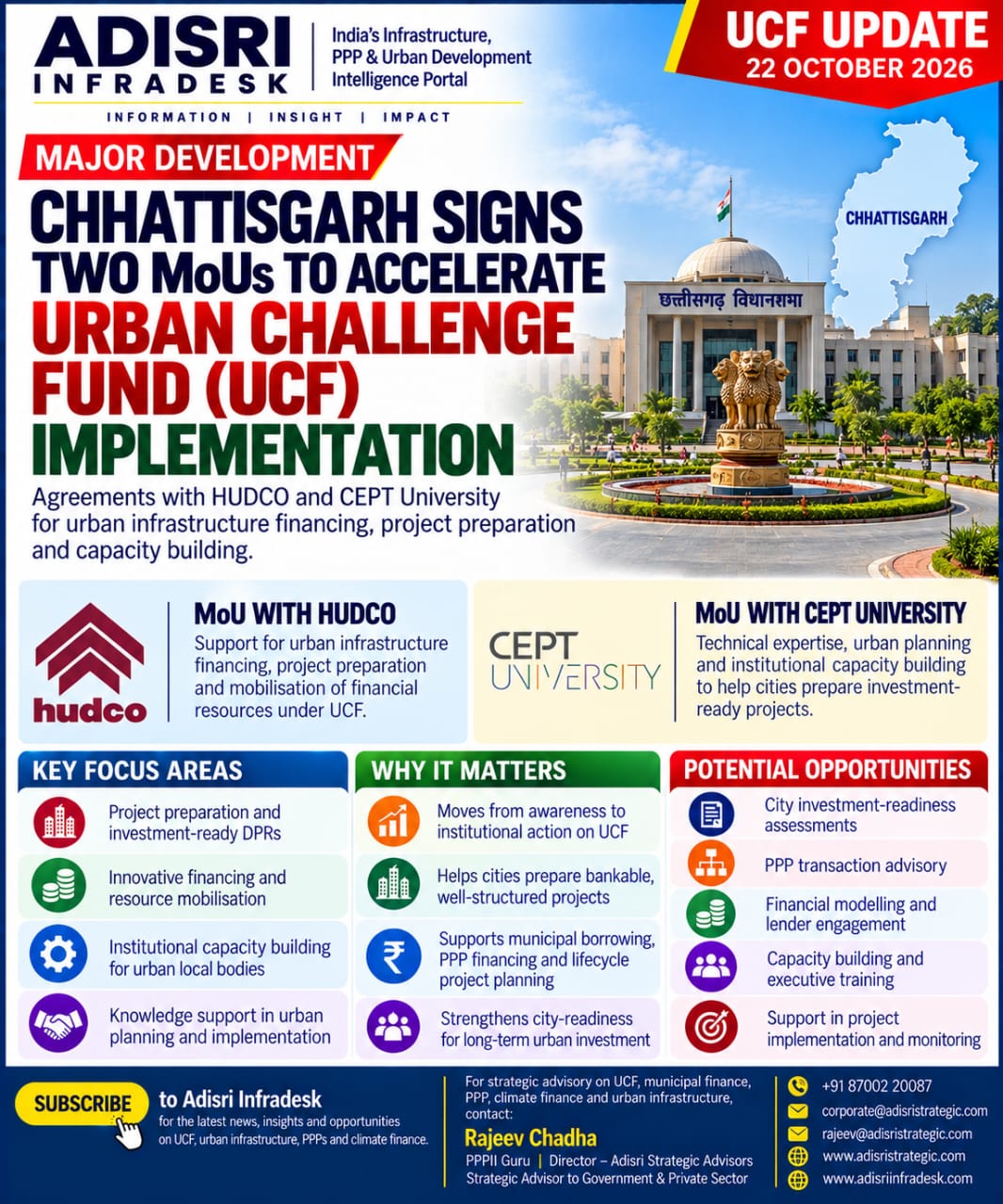
The Centre’s decision to establish the ₹1 lakh crore Urban Challenge Fund is undoubtedly a step in the right direction. Its design itself marks a shift in India’s urban financing architecture: central assistance capped at 25% of project cost, at least 50% to be mobilised from market sources, and the Fund is expected to catalyse nearly ₹4 lakh crore of urbaninvestment over five years.
But this step can only transform into a leap when the balance 75% of funding is raised through market-based borrowing, public private partnerships, municipal bonds and institutional reforms that improve the creditworthiness and financial capacity of urban local bodies. The launch of the Rs. 5,000 crore Credit Repayment Guarantee Sub-Scheme alongside the UCF is itself an acknowledgment that many cities, especially smaller urban local bodies, will struggle to access market finance unless their risk profile is improved.
Not to miss, the UCF changes the very genesis of urban development financing in the country. It pushes cities away from a pure grant-seeking mind-set and makes the fund a stress test of the country’s municipal and local governing body’s capacity.
Cities to be successful as growth-hubs must be self-sustaining and capable of raising municipal bonds, structuring public private partnership projects, monetising land and transit-linked assets, ring-fencing user-fee revenue streams, improving property tax buoyancy and strengthening accounting and disclosure standards.Useful lessons can be drawn from the city of Copenhagen, where large-scale urban regeneration and metro expansion were enabled by the Copenhagen City & Port Development Corporation, a publicly owned but commercially managed vehicle that leveraged land monetisation, borrowing and coordinated planning to finance city-building.
The city was able to transform public land assets and rising land values into a source of long-term infrastructure funding by considering land, transport, and finance as mutually reinforcing components of urban development.
It is thus imperative that focus is brought on urban governance reforms as urban redesign many a times gets stalled due to fragmented land records, overlapping jurisdiction of development authorities, weak metropolitan coordination, absence of unified transport-land use planning etc. Mumbai offers a live example of why urban governance reforms are indispensable to urban redesign.For a long time, the city’s metropolitan area has struggled to coordinate transportation investments with land-use planning across a much larger urban area rather than within a single municipal boundary, as well as several planning and implementing agencies and dispersed jurisdictions. It is thus noteworthy that the Mumbai Metropolitan Region Development Authority and the Unified Mumbai Metropolitan Transport Authority are striving for metropolitan-scale coordination, encompassing the integration of transport planning with regional and urban land-use strategies.
Simultaneously, initiatives like the planning of Mumbai 3.0 and the implementation of participatory land acquisition frameworks highlight that extensive urban transformation in India will increasingly rely on governance systems capable of integrating land, mobility, finance, and regional planning into a cohesive execution framework.
While the emphasis is often on building new infrastructure and planning for future migration, it is equally important to remember that urban competitiveness is shaped not only by what cities build, but by how effectively they maintain, operate and renew those assets over time through continuous upkeep, service reliability, asset management, lifecycle financing, operations & maintenance contracts and performance standards.