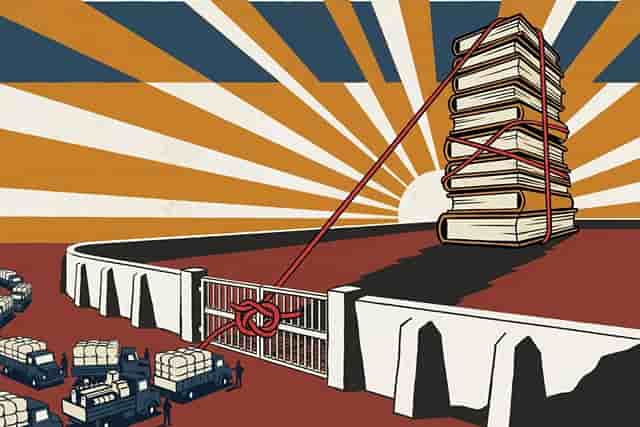
- The Lucknow PM MITRA park has spent two years looking for a private developer, while parks built directly by state agencies are already handing plots to factory owners.
- \
Three-and-a-half years ago, the central government picked a piece of land near Lucknow, Uttar Pradesh, for one of its new mega textile parks, called PM MITRA parks (MITRA stands for ‘(Mega Integrated Textile Regions and Apparel’). Since then, the Uttar Pradesh government has put up a boundary wall around the site and a gate, and brought a road, electricity and water to it. But no factory has come up there yet, because the land inside has not been ‘developed’.
Developing the land means laying roads, drains and power lines across the site and dividing it into plots for factory owners. At Lucknow, this work is to be done by a private company, known as a master developer, which would build the park and then run it for up to 50 years. The park has been looking for such a company for about two years without finding one.
The partnership parks are slower because of everything that has to happen before a developer can be hired. The government first has to write a contract that will bind the company for decades, and committees in the central government have to check it. If anything in it changes, it goes back to them. Private companies then study the terms and decide whether they want to bid at all. A state agency building a park on its own skips these steps and can start on the roads and plots straight away.
At Lucknow, the state first called for bids nearly two years ago. A consultant advising the state government told Swarajya that the call was withdrawn after the central government asked for changes to the rules for bidders and to parts of the contract. The rewritten papers were cleared about a year and a half after that first call, and a new call for bids went out this year. Its deadline has since been pushed back at least three times.
P C Thakur, the officer in charge of the park, told Swarajya, “There was no fault of the department. The process is tough and needs the Centre’s approval. The procedural issues caused the delay.” He has a point, since most of the time has been lost in the government’s own paperwork, and no private company has put in any money yet.
The choice of process, though, was Uttar Pradesh’s own. When the scheme began, its rules treated the partnership with a private party as the normal way to build these parks and allowed the direct route (state government developing on its own) only in exceptional cases.
Each state then proposed how its own park would be built. Most went with their own agencies, and Uttar Pradesh was one of the three that went with a partnership. The central government has since said the other routes are just as acceptable.
The parks on the direct route are further along, though two of the four had a head start. They were set up on or beside old industrial areas, with an agency already there to run them, and one of them is the only PM MITRA park where factories are working today.
The other two began on bare land, as Lucknow did. They are in Madhya Pradesh and Tamil Nadu, and both are already giving out plots to factory owners. The Madhya Pradesh park has nearly finished building its main infrastructure. Since these two started out in much the same position as Lucknow, the main thing that separates them from it is who is doing the building.The scheme had good reasons for preferring the partnership route in the first place. A private developer brings its own money, so the state does not have to pay for the whole park. At Lucknow, the central government has promised a grant and the developer would cover the rest, while in Madhya Pradesh and Tamil Nadu the state agencies are paying that share themselves.
For Uttar Pradesh, the delay comes at a time when its textile industry is growing fast. Over the past six years, the state’s exports of textiles, clothes and handicrafts have grown faster than those of any other big exporting state. More than half of them come from the district around Noida, and that district makes garments, which is only the last stage of a long process.

UP’s textile growth over the last six years in comparison to other states. 
How UP is too dependent on Gautam Buddh Nagar for its textile exports. Before cloth reaches a garment factory, cotton has to be spun into yarn, the yarn woven into cloth and the cloth dyed and printed. The government sums this up as farm, fibre, factory, fashion and foreign markets, and the PM MITRA parks are meant to bring all these stages together in one place. The factories around Noida do only the cutting and stitching, and they buy most of their cloth from other states.
The Lucknow park is supposed to bring those earlier stages into the state. It has room for spinning mills, weaving units, dyeing and printing works and garment factories. By late last year, nearly a 100 companies had signed agreements to set up there. They include one of India’s biggest business groups, which wants to spin and weave, and firms that make denim and industrial yarn. If they come, garments made near Noida could be made from yarn and cloth produced within Uttar Pradesh.
Until a developer prepares the land, those companies can only wait. But the state does not have to repeat this with the two further parks it has proposed, one of them in Kanpur, on land that once belonged to closed mills and a government textile company. The central government now accepts all the routes, so Uttar Pradesh could build these parks through its own agencies.
Doing so would help only if the state’s agencies work faster than one of them has near Noida. A garment park there, built by a state development authority for the district’s exporters, was meant to be ready some years ago. Most of its plots have been given out. Early this year, however, building work had started on fewer than one in ten, and the authority still did not have some of its land.
Finding one has meant nearly two years of contract-writing and checks by the central government. Parks that state agencies built on their own, on the same kind of bare land, are already giving out plots.
The partnership route may still produce a well-run park once a developer signs, and until one does, the companies waiting to set up in Lucknow cannot start.
For its next two parks, Uttar Pradesh can pick the direct route, though the garment park near Noida shows its agencies will also need to work faster than they have so far. Textiles are among the state’s biggest employers after farming, and the more than one lakh jobs expected from the Lucknow park alone depend on both choices.