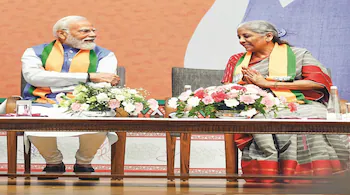
Prime Minister Narendra Modi on October 21 held a meeting with permanent members of the Economic Advisory Council to the Prime Minister (EAC-PM), Finance Minister Nirmala Sitharaman and finance ministry officials to discuss the state of the Indian economy, sources familiar with the discussions told Moneycontrol.
“The meeting was on the current state of the Indian economy. How to navigate the economy amid external uncertainties, enhance ease of doing business and revisit existing policies to attract more investment were some of the key topics of discussion,” one source said.
The meeting also came ahead of preparations for the Union Budget 2027.
On October 16, Sitharaman said India had managed to sustain its growth despite global headwinds and had been the fastest-growing major economy over the past four to five years.
“India, much against all the odds, is able to keep up the growth. We have been the fastest growing major economy in the past four-five years,” she said in an interview with the Atlantic Council.She attributed the country’s growth, in part, to inclusive policies, access to resources and skilling for young people, while stressing the importance of fiscal prudence.
“Particular reasons for it I would think is being inclusive and making sure everyone has access to resources and access to skilling for the young and making sure that fiscal prudence is not lost in this. We are conscious that we have a responsibility with public money and therefore, have a very clear understanding that we can’t be splurging money, even as we have to take care of those who are vulnerable in the economy,” the finance minister said.
On October 19, Sitharaman said the ease with which investors could exit their positions had contributed to the recent weakness in Indian equities. She also warned that excess liquidity in the market could continue to weigh on performance.
Meanwhile, minutes of the Monetary Policy Committee (MPC) meeting released on October 21 showed that members flagged the risk of supply-side inflation spreading more widely through the economy. Higher input costs, rising inflation expectations and strong credit growth strengthened the case for monetary tightening, the minutes showed.