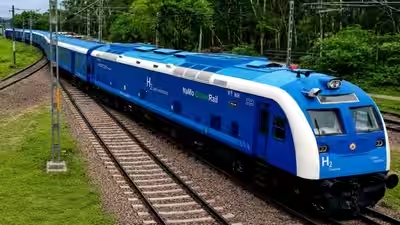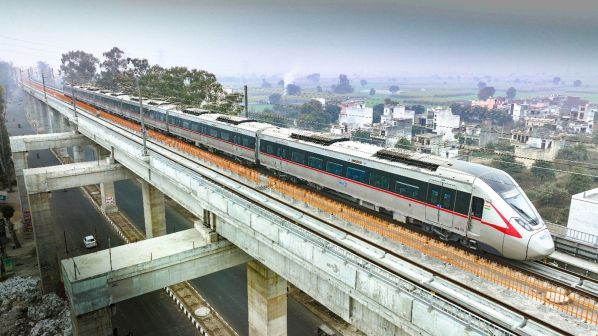
INDIA’s Ministry of Housing and Urban Affairs, which is responsible for urban rail, has approved the construction of a 93.1km commuter line from Delhi to Bawal. This will be the second line to be built under Phase 1 of the Regional Rapid Transit System (RRTS) or Namo Bharat programme in the National Capital Region.
The ministry will now request final approval for the project from the Union Cabinet, which is expected within a month.
Estimated to cost Rs 323.3bn ($US 3.6bn), the new line will combine 55.2km of elevated infrastructure with 37.9km in tunnel, running from Sarai Kale Khan in Delhi and serving 13 new stations. According to the National Capital Region Transport Corporation (NCRTC), which is delivering the RRTS programme, the new line will cut the journey time between Delhi and Bawal from around 3 hours to 1h 7min and is expected to take 100,000 vehicles off the roads.
The final sections of the first RRTS line, which will run for a total of 82km from Delhi to Meerut, are expected to open shortly and this project is costing Rs 302.7bn. NCRTC managing director, Shalabh Goel, told IRJ that construction costs of future RRTS lines are likely to be around 10% lower while maintaining the same design speed of 180km/h.
Experience gained during the construction of the first RRTS line will result in savings made from employing smaller tunnel boring machines (TBM) with a diameter of 5.8m, compared with 6.5m on Delhi – Meerut. “Other value engineering strategies can be adopted, such as reducing the width of viaducts and planning fewer station entrances,” Goel says.
Final two sections
Of the 82km Delhi – Meerut line, 55km is in now service between New Ashok Nagar and Meerut South. The final two sections, New Ashok Nagar – Sarai Kale Khan and Meerut S
South – Modipuram, have been approved by the Commissioner of Metro Railway Safety following trial operations, but opening has been delayed as apparently India’s prime minister, Narendra Modi, has not been available to perform the inauguration ceremony. “The line is expected to be inaugurated shortly,” says an NCRTC spokesman.
Once the Delhi – Meerut line is fully operational, it is expected to carry 167,000 passengers a day, minister of state, Tokhan Sahu, told the lower house of Parliament on February 5. The new line has already had a strong impact on local communities through the implementation of transit-oriented development (TOD) policies, including new towns such as New Meerut and New Ghaziabad, planned on greenfield sites around RRTS stations.
“These projects aim to promote high-density, mixed-use development and decentralisation of employment along the corridor, easing pressure on Delhi’s core, while supporting polycentric regional growth,” says the annual Economic Survey presented to Parliament last week. The survey also identifies 2900km of potential new RRTS lines across India, including Bengaluru – Mysuru – Tumakuru – Hosur, Chennai – Vellore – Villupuram – Chengapattu and Hyderabad – Warrangal.
Other RRTS projects
Under Phase 2 of the Delhi RRTS programme, an extension is planned from Bawal to Behror in Rajasthan, while the Haryana state government has already approved the Delhi – Shahjehanpur – Neemrana – Behror and Delhi – Panipat projects. Competing demands for the construction of RRTS lines have been emerging from other states, including Kerala in southern India where the state government has approved a plan to build a 583km RRTS corridor connecting Thiruvananthapuram with Kasaragod. The line will open in phases up to 2036 and cost an estimated Rs 1.92 trillion.