If you live around Najafgarh, Uttam Nagar, or the outer parts of Dwarka, you don’t need traffic data to tell you what’s wrong. You feel it every morning. Narrow roads, slow-moving vehicles, and long stretches where nothing really moves.
The Delhi government is now trying a different approach. Instead of widening surface roads again, it plans to go underground.
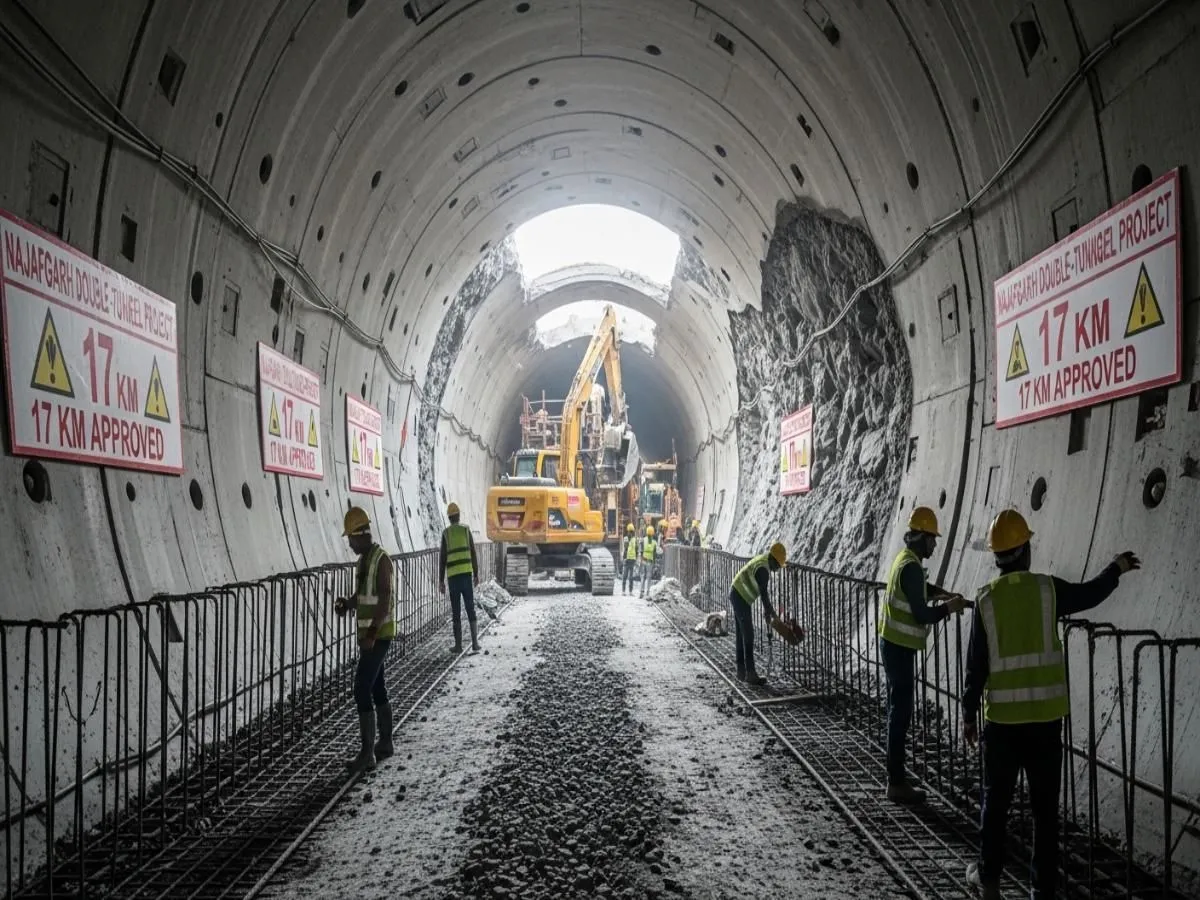
A 17-kilometre double-lane road tunnel is proposed along the Najafgarh Drain. It’s meant to carry through-traffic below ground, so local roads above can breathe a little.
This is not a metro tunnel. It’s a road tunnel – for cars, taxis, buses, and other vehicles.
Najafgarh 17-KM Double-Tunnel Corridor: Route
The corridor is planned mostly along the left side of the Najafgarh Drain. The stretch begins near the Dansa regulator and runs up to Jhattikara, close to the Delhi- Haryana border.
This entire belt cuts through areas that sit awkwardly between villages, colonies, and fast-growing residential pockets. Roads here were never designed for today’s traffic load. The tunnel is meant to act like a shortcut – taking long-distance vehicles underground while local traffic stays on top.
It will also connect directly to Urban Extension Road-2 (UER-2), which matters because UER-2 is slowly becoming one of Delhi’s key outer connectors.
Delhi Government approves 17-km underground double-tunnel corridor for Najafgarh
Najafgarh 17-KM Double-Tunnel Corridor: Project Details
|
Detail |
What’s planned |
|
Total length |
About 17 km |
|
Type |
Underground road tunnel |
|
Lanes |
Double lane |
|
Route base |
Along Najafgarh Drain |
|
Major connection |
UER-2 corridor |
Najafgarh 17-KM Double-Tunnel Corridor: Project Cost
There’s no final cost number yet. Tunnel projects are expensive. Between engineering, drainage control, safety systems, ventilation, and traffic management, costs add up fast. Similar projects in Delhi have easily crossed thousands of crores once construction begins. Officials are still working on detailed planning and approvals. The actual figure will likely come once tenders are floated.
Najafgarh 17-KM Double-Tunnel Corridor: Timeline
No official date has been announced. Realistically, this is not a quick build.
First comes design approval. Then soil and water studies – especially important since the tunnel runs next to a drain. After that, tendering and phased construction.
If work starts smoothly, people should think in years, not months.
Residents nearby should also be prepared for temporary disruption during construction. That’s unavoidable with projects of this scale.
Najafgarh 17-KM Double-Tunnel Corridor: Importance
This corridor isn’t about fancy infrastructure. It’s about everyday relief.
-
Through-traffic moves underground
-
Surface roads become usable again
-
Travel times stabilise
-
Heavy vehicles get a cleaner route
-
Nearby colonies see less chaos
For someone driving daily between southwest Delhi and outer corridors, even saving 15-20 minutes makes a difference.
What Changes for Nearby Areas
Over time, connectivity shapes neighbourhoods. Better roads often mean:
-
Easier access to jobs
-
Faster emergency movement
-
More interest from businesses
-
Slight pressure on real estate
But more importantly, it changes daily routines. Less stress. Fewer detours. More predictable travel.
Wrapping Up: Najafgarh 17-KM Double-Tunnel Corridor
Delhi can’t keep widening roads forever. There’s no space left. Projects like this show a shift in thinking – using underground corridors to separate fast movement from local life.
It won’t solve everything. No single project ever does.
But for people who use these roads daily, this tunnel could quietly become one of those things you don’t think about anymore – because it works.
For residents and investors, improved connectivity also means rising real estate interest. Options like property in Najafgarh and flats in Uttam Nagar are expected to become more attractive as infrastructure upgrades reshape southwest Delhi’s housing landscape.