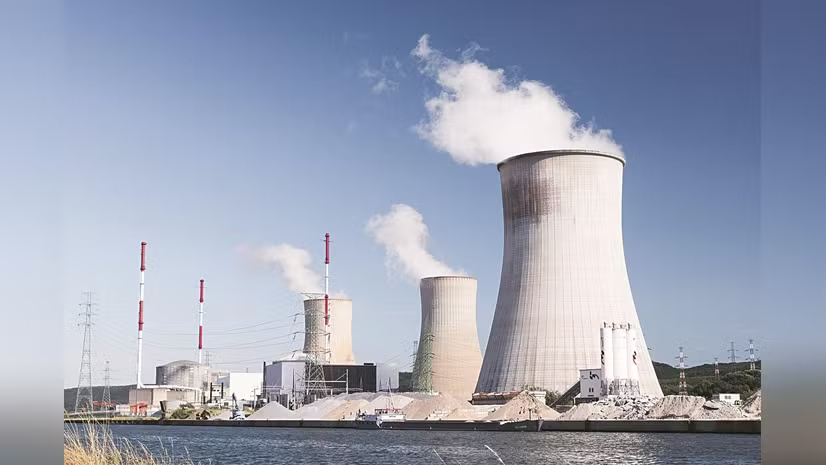
India needs around Rs 23-25 trillion investment in nuclear energy to achieve 100 GW of installed capacity by 2047 and sustained average capacity additions of 4.5 GW annually after 2030-32, according to a report released last week by The Energy and Resources Institute (TERI).
“Achieving 100 GW of nuclear capacity by 2047 requires a significant acceleration in capacity addition where the scale and pace of expansion required become critical,” the report said. India’s current nuclear capacity is 8.8 GW, and projects under construction are expected to raise the capacity to around 22 GW by 2030-32, it added, saying that the remaining expansion needs an average annual addition of about 4.5 GW.
The report on the pathways for Small Modular Reactors (SMRs) deployment states that early government support, such as the use of project-specific special purpose vehicles (SPVs) for capital pooling to de-risk these projects, is an economic intervention that can lower long-term system costs, enable private sector participation, and support the development of a competitive domestic supply chain. It further highlights the importance of regulatory readiness, standardised reactor designs, skilled human resources, coordinated fuel supply and waste management systems, and sustained public outreach.
“A phased and roadmap-driven approach beginning with pilot and demonstration projects, followed by standardisation and scale-up, will be essential to integrate SMRs effectively into India’s energy system while preserving safety, cost discipline, and public confidence,” the report noted.
The three-phased approach included the completion of ongoing Pressurised Heavy Water Reactor (PHWR) or Fast Breeder Reactor (FBR) projects and updating regulatory frameworks/policy for SMRs by 2030. It also includes initial fuel fabrication expansion, site selection or evaluation for SMRs, partnership with key SMR designs for the indigenisation of technology, and pilot projects for heating applications, such as desalination and district cooling using Bharat Small Reactors (BSRs).
Thereafter, the second phase from 2030 to 2040 involves serial PHWR/FBR deployment, initial SMR commercialisation and fleet development, and development of the thorium fuel cycle. The third phase from 2040 to 2047 includes large-scale capacity addition, SMRs for green hydrogen production and hard-to-abate sectors, deployment of thorium-based Advanced Heavy Water Reactors, and integration with the national grid for base-load flexibility.
The report shows that SMR development is advancing across a wide range of reactor designs, fuels, and applications in countries such as the United States, Canada, China, Russia, France, and the United Kingdom. They are actively adapting regulatory frameworks, licensing pathways, and industrial ecosystems to enable SMR deployment, and India must take lessons from these efforts to manage risk and accelerate deployment.