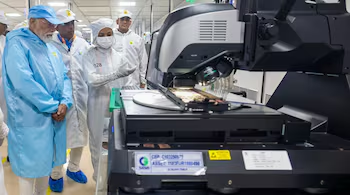
Prime Minister Narendra Modi on Saturday inaugurated commercial production at CG Semi’s Outsourced Semiconductor Assembly and Test (OSAT) facility in Gujarat’s Sanand. It marks the third semiconductor venture to start commercial production in India this year, with two more set to begin operations in 2026.
The facility, operated by CG Semi Private Limited—a joint venture between CG Power and Industrial Solutions, Renesas Electronics Corporation and Stars Microelectronics—has completed equipment installation, process stabilisation, workforce training and customer qualification after being inaugurated in August 2025.
Commercial production has now commenced, with the plant capable of producing up to 300 million semiconductor units annually at peak capacity. During the inauguration, the Prime Minister was presented with the first batch of chips manufactured at the facility, which are set to be exported to Japan.
The G1 facility is part of CG Semi’s planned investment of more than Rs 7,600 crore over five years to develop two OSAT plants in Sanand. Construction of the second unit, G2, is underway and is expected to significantly expand production capacity once commissioned.
Addressing the gathering, PM Modi said India is building an integrated electronics manufacturing ecosystem spanning finished products, components and semiconductors, with domestically manufactured chips expected to support emerging technologies such as artificial intelligence and robotics.
PM Modi said the semiconductor push builds on the rapid expansion of India’s electronics manufacturing sector over the past decade, citing a 33-fold increase in mobile phone production and an 11-fold rise in electronics exports since 2014. “India will not only manufacture chips, but the nation’s youth will also use ‘Made in India’ chips to accelerate the Artificial Intelligence, robotics, and next-generation tech revolution” he said.
There is unwavering faith in the power and talent of India’s youth, the PM said, adding whenever a new industrial revolution occurs globally, it creates the greatest number of opportunities for young people. “The expansion of the semiconductor industry in India did not happen overnight. It is the next step in the electronics revolution that has taken place in India over the past decade,” he said as he was handed the first semiconductor chips made at the company, to be exported to Japan.
Drawing a parallel with the IT revolution and rise of smartphone manufacturing, he said the current wave of semiconductor and AI technologies would create an entirely new world of skills and employment. “The idea is yours, the support is mine,” he told the youth.
“First products, then components and now semiconductors…India is building the entire electronics value chain. This is the roadmap to Viksit Bharat. This is the next phase of Make in India,” PM added.
He said his government’s goal is to build a complete semiconductor ecosystem in India, from chip design to fabrication and packaging.
Sanand emerging as semiconductor hub The Prime Minister said Sanand is evolving into a semiconductor manufacturing hub comparable to global clusters, adding that chip packaging operations at the facility are expected to attract ancillary industries such as chemical suppliers, testing laboratories and semiconductor design centres.
He also referred to earlier attempts to establish a semiconductor manufacturing project in Gujarat that did not materialise, saying the current policy framework has enabled faster execution of such investments.
According to PM Modi, India is now expected to have five operational semiconductor facilities by 2026, compared with the earlier target of four.