India has set itself an ambitious target: to increase the share of natural gas in its primary energy mix from around 6 per cent today to 15 per cent over the coming decade.Natural gas is cleaner than coal and liquid fuels, supports renewable power when solar and wind are unavailable, and remains an essential feedstock for fertilisers and petrochemicals.
Over the past two decades, India has built much of the required foundation. The national gas grid has expanded, LNG terminals have come up on both coasts, and City Gas Distribution licences have been awarded across most of the country.
Yet there is a paradox, while India has invested heavily in LNG import infrastructure, including both terminals and pipelines, several are operating at low utilisation levels. At the same time, many industrial clusters, ports, manufacturing centres and new investment zones still do not have adequate access to natural gas.
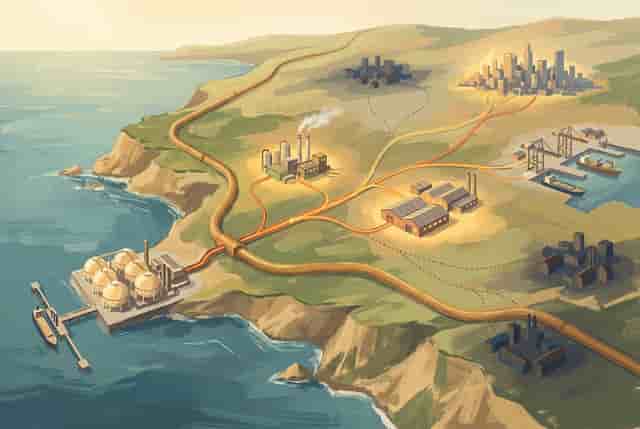
The problem is therefore not merely one of supply, it is the missing layer of regional connectivity.Gas infrastructure must be developed as an integral system comprising LNG terminals, trunk pipelines, regional pipelines. Industrial demand and City Gas Distribution networks must move together. When one part develops ahead of the others, infrastructure remains underutilised and sometimes stranded.
India now needs institutions at the State level that can bring together supply, transportation and demand.
How India Builds its Other Infrastructure
India has addressed similar problems in nearly every other infrastructure sector.
Roads: the National Highways Authority of India develops the national arterial network, while state governments build the state highways and regional roads that connect ports, industries, towns and villages to it.
Electricity: Power Grid Corporation operates the interstate transmission system, while state transmission utilities build the regional lines that carry power to cities, industrial areas and distribution companies.
The Union creates the national backbone, and the states build the regional infrastructure around it.
India’s Gas Infrastructure Build Out So Far
Natural gas has evolved differently. GAIL and other transmission companies have built a large national pipeline network connecting domestic gas fields, LNG terminals and major consumption centres. This has been a major infrastructure achievement.
But industrial growth is increasingly shaped by the states. They identify industrial corridors, ports, fertiliser plants, refineries, steel clusters, data centres, logistics hubs and manufacturing zones. They compete for investment and provide land, incentives and local infrastructure.
Yet the gas pipelines needed to support these projects often depend on national investment decisions. National companies must naturally evaluate projects from the perspective of the country as a whole. A pipeline that is strategically important to one state may not immediately become a national priority.
This is not a failure of GAIL or of the existing system. It is simply the limitation of expecting a national institution to respond to every regional opportunity.
Need For Second Institutional Layer
National trunk pipelines should continue to be developed and operated by GAIL and other authorised transmission companies. They have the technical expertise, financial strength and national perspective required for cross-country infrastructure. What is missing is an equivalent institution at the state level. Every major state, particularly every coastal state, should have a State Gas Infrastructure Company responsible for planning and developing regional gas connectivity. Its role would be to connect national pipelines and LNG terminals to manufacturing clusters, fertiliser plants, refineries, City Gas Distribution systems and future growth centres.
Gujarat Shows the Way
India already has a successful example.
More than two decades ago, Gujarat established Gujarat State Petronet Limited to build an intra-state gas grid. Over time, the network expanded across the state and connected LNG terminals, refineries, fertiliser plants, power stations, ceramic clusters, industrial users and City Gas Distribution networks. Gujarat Gas, in parallel, became the country’s largest City Gas Distribution company.
Gujarat is now one of India’s most gas-intensive industrial economies. Industries did not have to wait for every regional pipeline decision to originate from the national level. The state developed its own institutional capacity to identify demand and extend connectivity.
We do not need to invent a new model but instead adopt an existing one.
A Fresh Push for Regional Connectivity
The model I propose is straightforward.
Every major state should designate or establish a State Gas Infrastructure Company responsible for developing the state’s gas backbone and regional pipeline network.
GAIL and other national transmission companies would continue to build and operate the trunk system. The state company would develop the pipelines needed to connect that system to local economic activity.
This is a clearer division of responsibility, not duplicate infrastructure. National companies should focus on national projects; state institutions should focus on regional industrial priorities.
The model does not require a fundamental change in the regulatory structure. Gas transportation would continue to be regulated by the Petroleum and Natural Gas Regulatory Board.
These are functions that a state government is well placed to perform because it has direct visibility into industrial policy, land allocation, investment promotion and regional growth.
Gas infrastructure would then cease to be an isolated engineering project. It would become part of the state’s industrial strategy.
Customers Fund the Regional Infrastructure
Unlike the national oil majors, a new state corporation may not be well capitalised. This model should therefore be accompanied by a different approach to financing.
Traditionally, infrastructure is often built first in the expectation that demand will follow. In some cases, however, this has produced underutilised assets because demand developed more slowly than expected.
A better approach is to allow infrastructure to follow committed demand.
This does not necessarily mean that customers must own the pipeline. Their participation could take several forms, including take-or-pay commitments, security deposits and advance tolling charges.
Andhra Pradesh: The First Demonstration – Reviving a Stranded Asset to Create a Model
Few states are better placed to demonstrate this model than Andhra Pradesh.
The Andhra Pradesh Gas Infrastructure Corporation was established to promote gas infrastructure in the state. Along with GAIL, it created the Andhra Pradesh Gas Distribution Corporation as a 50:50 joint venture to develop the Mallavaram-Srikakulam natural gas pipeline.
The project was conceived when large volumes of gas from the Krishna-Godavari Basin were expected to support rapid industrial growth across coastal Andhra Pradesh.
Those assumptions later changed. Domestic gas production did not develop as anticipated. The commercial momentum behind the project weakened. Although substantial investments had already been made in land and parts of the pipeline, the project stalled.
It is now treated as a stranded investment, with more than ₹300 crore invested. That would be the wrong conclusion.
The Mallavaram-Srikakulam pipeline should instead become the starting point for Andhra Pradesh’s State Gas Grid and an opportunity to test the demand-led financing model.
A fertiliser plant planned under the recent policy along this route could become one anchor customer. HPCL’s requirement for RLNG could become another. These customers can provide the long-term commercial commitments required to finance the completion of the pipeline. Data centres coming up near Visakhapatnam could also be aggregated over time once the anchor demand creates the infrastructure.
The Government of Andhra Pradesh would recover value from investments already made and could then create an institutional platform capable of expanding the gas network to other parts of the state.
Amaravati, being developed as a modern model city, can plan and integrate piped gas supply to every household, followed by other cities and clusters.
Each extension of APGIC’s network can be developed based on committed demand. The network would then expand in response to actual economic activity rather than optimistic projections.
A New Paradigm for Completing India’s Gas Economy
This idea is relevant across India.
Every coastal state with LNG infrastructure, or the potential to develop it, faces the same question: how will its imported gas reach industries, cities and manufacturing clusters? Odisha, Tamil Nadu, Kerala and Maharashtra, with existing or proposed LNG terminals, all present different versions of the same opportunity.
What each requires is a new institutional layer: a state-sponsored gas distribution company.
India’s goal of increasing natural gas from around 6 per cent to 15 per cent of its primary energy mix is achievable, but only if this state-level institutional architecture evolves. A national gas grid can carry gas across the country. It cannot, by itself, respond to the industrial priorities of every state. That responsibility must be shared with state-level institutions that understand local demand and regional development. States need not remain passive beneficiaries waiting for national infrastructure to arrive. They can become architects of their own energy systems.
Gujarat demonstrated how a state can build a successful gas economy around domestic gas, LNG terminals, regional pipelines and City Gas Distribution.
Andhra Pradesh now has an opportunity to demonstrate the next version of that model: a gas economy built around LNG imports, committed industrial demand, regional connectivity and a strong state institution.
If India is serious about becoming a 15 per cent gas economy, one missing layer may prove to be one of the most important infrastructure opportunities of the coming decade. The second one will be discussed in the next part.