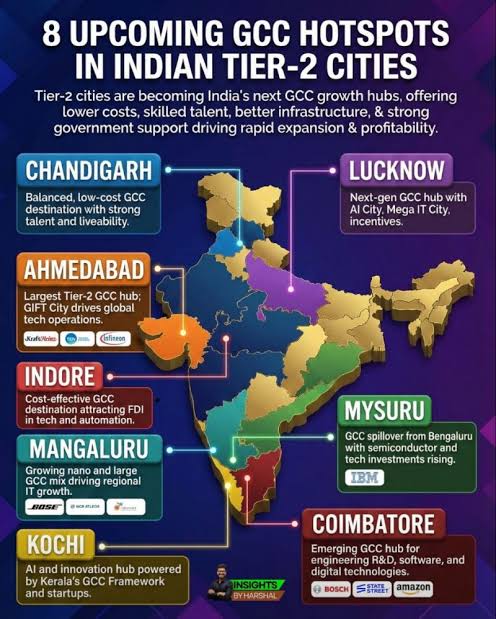
As companies look beyond traditional hubs such as Bengaluru, Hyderabad, Pune and Chennai, Tier-2 and Tier-3 cities are increasingly being evaluated not merely as lower-cost alternatives, but as potential talent ecosystems in their own right.
Highlights
- For standard, process-driven, business-as-usual and back-office roles, emerging cities can offer significant cost advantages. For scarce skills, however, geography matters far less.
- As GCCs take on more complex technology, analytics, engineering and R&D mandates, the availability of specialised skills is becoming a more important consideration.
- Standard operating and middle or back-office activities may be suitable for Tier-2 and Tier-3 cities, while AI, data and advanced engineering roles may still require established metropolitan talent pools.India’s Global Capability Centre (GCC) landscape is entering a new phase. As companies look beyond traditional hubs such as Bengaluru, Hyderabad, Pune and Chennai, Tier-2 and Tier-3 cities are increasingly being evaluated not merely as lower-cost alternatives, but as potential talent ecosystems in their own right.The shift is being driven by rising costs and talent competition in major metros, while improvements in infrastructure, education and connectivity are making smaller cities more viable for global operations.
India now has more than 1,800 GCCs employing over two million professionals, with around 100 new centres being added each year, according to EY.As this footprint expands, the question for companies is becoming more nuanced. Can emerging cities deliver sustainable cost advantages without compromising on talent quality, capability and retention?
For Rajita Singh, Chief People Officer-India & Global Delivery HR leader, Kyndryl, the location decision has moved beyond a simple comparison of salary costs.“Organisations are increasingly assessing the depth of the talent pool, leadership potential, scalability and the broader ecosystem a city can provide.” Singh said.
The objective, she argued, is not to identify “the lowest-cost location”, but markets where organisations can attract, develop and retain capabilities over the long term.
The numbers suggest that emerging locations can offer meaningful economics.EY analysis cited in the responses finds that attrition in Tier-2 locations can be up to 10 percent lower than in Tier-1 cities, while the cost of living can be 10 percent -35 percent lower than nearby Tier-1 locations.
But lower wages alone are unlikely to determine the next wave of GCC expansion. As GCCs take on more complex technology, analytics, engineering and R&D mandates, the availability of specialised skills is becoming a more important consideration.This creates a two-speed talent market. For standard, process-driven, business-as-usual and back-office roles, emerging cities can offer significant cost advantages. For scarce skills, however, geography matters far less.
Alpana Dutta, Partner, People Consulting, EY India, points to EY’s Future of Pay 2026 research, which shows that emerging technology capabilities such as AI, GenAI, machine learning, engineering, cybersecurity and cloud can attract skill premiums of 30 percent – 40 percent, with some roles commanding premiums of up to 40 percent.
Nearly 45 percent – 50 percent of organisations are also moving towards skills-based pay, linking compensation increasingly to the scarcity and economic value of capabilities rather than simply job title or location.
That means a company may save on compensation by moving a conventional technology or operations role to an emerging city, but the same logic may not apply to an AI architect, GenAI engineer, data scientist or cybersecurity specialist.For these roles, compensation benchmarks are increasingly national and sometimes global rather than determined by the city where the employee sits.
The emerging-city opportunity, therefore, depends heavily on what kind of work organisations intend to locate there.
Yadhu Kishore Nandikolla, Head- HR, Evernorth Health Services India, said workforce planning should begin with the nature of the work, followed by an assessment of whether the location can provide the required talent.
Standard operating and middle or back-office activities may be suitable for Tier-2 and Tier-3 cities, while AI, data and advanced engineering roles may still require established metropolitan talent pools.This is already reflected in the changing geography of GCCs. EY’s research identifies cities including Kolkata, Ahmedabad, Jaipur, Vadodara, Chandigarh, Indore, Bhubaneswar, Visakhapatnam, Coimbatore and Kochi as locations increasingly being evaluated on the basis of talent, cost, infrastructure and state policy.
More recently, smaller cities such as Mangalore, Bhopal and Aurangabad have begun entering the GCC conversation, with Tier-2 cities accounting for an estimated 30 percent -32 percent of new job postings, according to NLB Services.
Kolkata offers an example of how the model could evolve. In Eastern India more than 20 GCCs operate in the region and noted that Kolkata is developing talent depth in IT, analytics and engineering, allowing GCCs to take on more complex, enterprise-critical mandates. The significance is that emerging hubs are no longer necessarily limited to transactional work.For companies, this points towards a distributed talent architecture rather than a wholesale migration away from metros. Mature hubs can continue to house specialist and leadership capabilities, while emerging cities can provide scalable talent pools for roles where supply, retention and cost economics are more favourable.
Infrastructure, universities, employable graduates, experienced professionals, leadership availability, government support and career opportunities all become part of the location equation.
As Singh puts it, the future of location strategy will be defined less by where work is done and more by where capability is created. For India’s emerging GCC hubs, that distinction could determine whether they remain low-cost delivery centres or become the next generation of global innovation and capability hubs