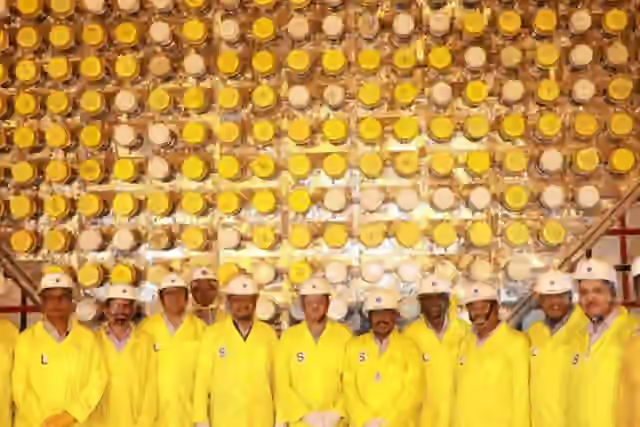
The Nuclear Power Corporation of India Limited (NPCIL) has commenced initial fuel loading at Unit 8 of the Rajasthan Atomic Power Project in Rawatbhata, marking a significant milestone in India’s indigenous nuclear power programme.
The 700 MW pressurised heavy water reactor (PHWR) is the fourth in a series of 16 indigenous reactors being constructed across the country as part of the government’s ambitious nuclear expansion plan.
The fuel loading process began after receiving clearance from the Atomic Energy Regulatory Board (AERB) following stringent safety and security reviews.
RAPP-8 will load a total of 4,704 fuel bundles across 392 coolant channels during the initial fuel loading phase.
The unit is expected to achieve first criticality and grid synchronisation in the coming months, following the successful trajectory of its sister unit, RAPP-7, which entered commercial operations in April 2025.
The Rajasthan site at Rawatbhata currently operates six PHWR units with a combined capacity of 1,180 MW.
The two new 700 MW units represent a significant technological leap from the site’s earlier generation reactors.
Construction of RAPP-8 began in September 2011, with the project experiencing delays and cost overruns before reaching this critical commissioning phase.
In January 2026, the unit successfully completed Primary Heat Transport System Hot Conditioning, bringing it substantially closer to fuel loading, criticality, and eventual grid synchronisation.
The indigenous 700 MW PHWR design incorporates advanced safety features including passive decay heat removal systems, containment spray systems, and steel-lined containment structures.
These Generation III reactors are part of India’s strategy to expand nuclear capacity from the current 8,780 MW to 22,480 MW by 2031-2032, with nuclear energy currently contributing approximately 2.8 per cent to the country’s electricity generation mix.