India’s long-standing campaign for a permanent seat on the United Nations Security Council (UNSC) has received fresh backing from four Central European countries at a meeting with External Affairs Minister S Jaishankar in New York.
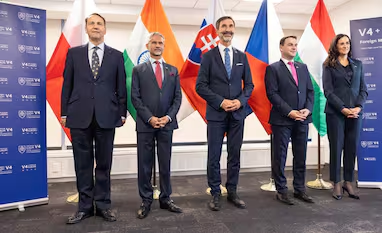
Hungary, Poland, Slovakia and the Czech Republic, the four members of the Visegrad Group, or V4, voiced collective support for India’s permanent membership during the first V4-India foreign ministers’ meeting on the sidelines of the 81st UN General Assembly.
Slovak Foreign and European Affairs Minister Juraj Blanar said the four countries agreed that India, as a member of the Global South and an emerging power in the Indo-Pacific, should have a permanent place on the Security Council. Jaishankar shared Blanar’s remarks on X.
What is the Visegrad Group?
The V4 is a regional grouping of the Czech Republic, Hungary, Poland and Slovakia. Formed in 1991, it provides a platform for cooperation among the four Central European countries on political, economic, security and other issues.
The V4-India meeting establishes a new collective channel for engagement between New Delhi and the four countries. Jaishankar described it as a “new historic occasion”, while the ministers agreed to hold annual foreign ministers’ meetings and establish an annual business forum.
The discussions also covered technology and innovation, defence, space, connectivity and people-to-people ties, according to statements from the meeting.
What the backing means for India
The endorsement adds a collective European bloc to India’s campaign for a permanent place on the 15-member Security Council. The council currently has five permanent members, the US, Russia, China, France and the UK, and 10 non-permanent members elected for two-year terms.
India’s permanent-membership campaign has received backing from the US, Russia, France and the UK. China is the only existing permanent member that has not explicitly endorsed India’s bid.
India is also part of the G4 grouping with Brazil, Germany and Japan, which has jointly pushed for an expansion of both permanent and non-permanent membership of the Security Council.
The latest V4 support, however, does not by itself change the reform process. Any expansion of the Council would require agreement among UN member states and amendments to the UN Charter, making the position of the existing permanent members particularly important.
The P5 and the question of ‘veto’
One of the central disagreements in the reform negotiations concerns the powers of any new permanent members, particularly whether they should receive veto rights.
The five existing permanent members have not agreed on a single model for expanding the Council. Countries differ over the number of additional seats, their regional distribution and whether new permanent members should have the same veto powers as the existing P5.
India has argued that there should not be a separate category of permanent members with fewer rights. In an April 2026 statement, New Delhi said there could not be a situation where some permanent members had veto rights while others did not, backing an “all or none” approach.
The African Union has also sought permanent representation for Africa and has argued that the veto should ultimately be eliminated. Until that happens, it has called for any new permanent members to receive the same rights as existing ones.
wider India-V4 relationship
The UNSC issue was part of a broader effort to institutionalise India’s engagement with the V4 countries.
Jaishankar said the two sides agreed that, as India’s relationship with the European Union deepens, New Delhi and the V4 should pursue special initiatives, including an annual business forum and regular meetings of foreign ministers.
The ministers also exchanged views on major global developments, including the Ukraine conflict and developments in the Gulf.