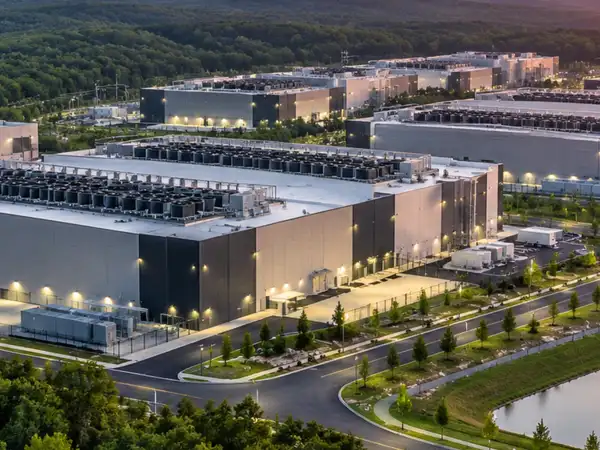
India’s data-centre industry is moving into a new phase as cloud adoption, Artificial Intelligence workloads and digital services push operators to build more capacity. CBRE estimates that India’s operational data-centre capacity had reached around 1.75 gigawatts (GW) by the end of H1 2026.
India’s Hyperscale Inflexion: Why 1.75 GW is Just the Starting Line
At the same time, total investment commitments since 2021 have climbed to $173 billion (around ₹16 lakh crore). The scale of planned expansion is also becoming clearer, with 92% of surveyed operators planning to add more than 100 MW of capacity over the next 24 months. This expansion is creating opportunities well beyond companies that directly own data-centre facilities.A leading telecom operator is positioned to benefit from connectivity and interconnection services, as over 35% of global internet traffic passes through its network. Another electrical equipment company with a presence in the marine and defence sectors is diversifying into data centres. Below is an operational and financial breakdown of both companies
#1 Tata Communications: The Connectivity Layer Behind India’s Data-Centre Boom
Part of the Tata Group, Tata Communications is a global communications technology player and digital ecosystem enabler. Its network spans 500,000+ km of subsea fibre and 200,000 km of terrestrial fibre. Over 35% of all global internet traffic is routed through its network. Tata Communications serves enterprises, cloud hyperscalers, media giants, and service providers.
Revenue Engines: Data Services and the Digital Portfolio Shift
The company operates in over 190 countries and territories. It serves about 300 of the Fortune 500 companies. Tata Communications divides its operations into a few core segments. Data Services is the largest business, accounting for 86% of Q1FY27 revenue. This business reported an EBITDA (Earnings Before Interest, Tax, Depreciation, and Amortisation) margin of 18.7%.
This includes core network connectivity, subsea bandwidth, and data centre services. Within the data services business, the digital portfolio segment accounts for approximately 50% of total data service revenue. The remaining 14% came from the remaining two segments: transformation services and voice solutions. .
In data centres, the company provides connectivity, cloud interconnection and digital infrastructure services. It sold 74% of its direct data centre business (STT Global Data Centres) in 2016 to focus on network platforms. However, it still holds a 26% stake in STT as an associate partner.
Tata still maintains ongoing commercial, network, and transmission agreements with STT. It builds custom network links that connect data centres for cloud providers, streaming platforms and financial institutions.
Network Moats: How Subsea Fibre Anchors Cloud Interconnects
Instead of operating as a primary colocation provider, Tata Communications supplies the underlying network infrastructure connecting data centres. In India, it connects directly to 102 carrier-neutral data centres and 6 captive data centres out of 112 Tier 3/4 facilities. It integrates 650+ Points of Presence (PoPs) into major data centres around the world.
Enterprise Hyperscaling: Deploying 800G Wavelengths for AI Workloads
For hyperscalers, the business constructs custom national long-distance network links for cloud providers. A major cloud provider needed to link its large data centres located across three big Indian cities. Tata Communications built and delivered a dedicated, custom fibre network for them.Having a dedicated, high-capacity long-distance network ensures that data moves between city data centres at maximum speed with zero delays or interruptions. The company is investing in 800G wavelength technology to move heavy AI data traffic between facilities. The company also has software-defined dynamic connectivity platforms.
Its IZO data centre dynamic connectivity platform automatically reroutes network traffic within seconds if a cable breaks. Businesses can scale their network bandwidth up or down on demand whenever data needs change. Its multi-cloud platform connects data centres directly to 80% of global cloud provider locations.
Its ThreadSpan software lets companies monitor and control network, cloud, and data centre operations from one dashboard. Overall, AI applications generate a high volume of data. Tata Communications uses its specialised B2B network to move this traffic with predictable speeds.
Balance Sheet Reality: Topline Expands 10.5% as Net Profit Slumps
Financially, the company’s consolidated revenue grew 10.5% year-on-year to ₹6,583 crore in Q1FY27. EBITDA grew 8.2% to ₹1,230 crore, with a margin of 18.7%. Net profit fell to ₹130 crore, down from ₹190 crore in Q1FY26. A fire at a data centre facility, provisions related to contractual commitments, and one-time charges impacted profits.
The company’s net debt stood at ₹10,400 crore with a Net Debt-to-EBITDA ratio of 2.1x. Looking ahead, management aims to deliver double-digit EBITDA growth for the full fiscal year 27, focusing on high-margin network services and software platforms (such as Threadspan, CoMotion, and MOVE).
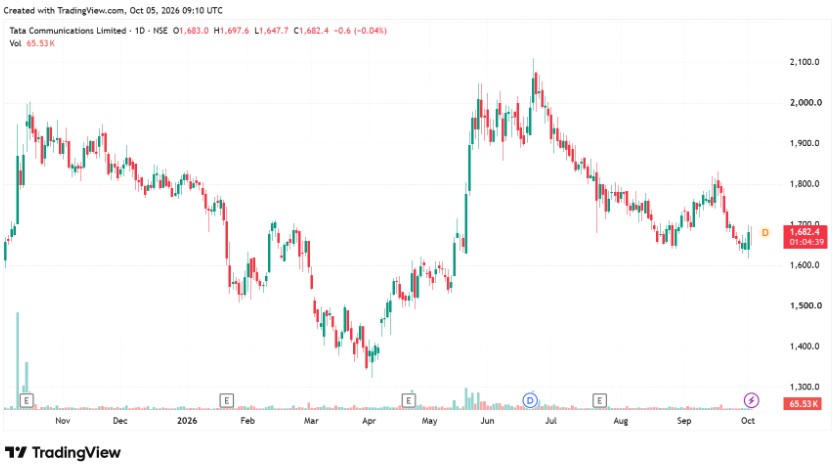
Tata Communications Share Price
#2 Marine Electricals: The Power Infrastructure Play on India’s Data-Centre Boom
Marine Electricals manufactures and supplies integrated electrical, power distribution, and navigation/communication solutions. The company is an Original Equipment Manufacturer across more than 25 major product categories. Its presence spans Defence and Naval Marine (the core) and Industrial and Urban Infrastructure.
Revenue Distribution: Segment Parity Between Marine and Industry
The Marine segment accounted for 39.7% of revenue of ₹259 crore in Q1FY27. This segment recorded a Profit Before Tax, Exceptional Items, and Interest (PBEIT) margin of 9.0%. The Industry segment contributed the remaining 60.3% of revenue, with a PBEIT margin of 9.0%. Effectively, the margins of both segments are identical.