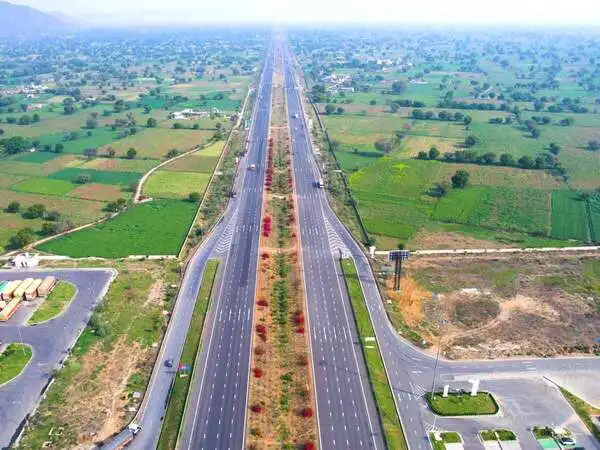
India’s national highway network has registered a remarkable growth in the last decade, growing from approximately 91,287 km in 2015 to over 1,46,572 km in FY26– a rise of more than 60 per cent.
This sustained push by the government for creating modern infrastructure is driven by the need for better connectivity, improving logistics efficiency and enhancing ease of travel for millions of citizens, all of which together help in economic growth.
The Ministry of Roads Transport and Highways (MoRTH), under the BharatMala Pariyojana I, focused on creating access-controlled high-speed corridors and expressways across the country.Bharatmala Pariyojana Phase-I, covering a length of 34,800 km across the country at an estimated outlay of ₹5,35,000 crore, was approved in 2017.
Under the programme, projects covering a total length of 26,425 km have been awarded, out of which 22,223 km has been constructed up to February 2026, according to MoRTH data.
According to data shared by the National Highways Authority of India (NHAI), several high-speed corridors and expressways, which have already been constructed and thrown open to the public, have significantly reduced travel times between major cities, while improving connectivity and providing faster, more efficient alternatives to conventional highway routes. Here are some of the key projects that are transforming road travel across the country:Key expressways that are changing road travel
Delhi-Meerut Expressway: The approx. ₹8,340 crore Delhi-Meerut Expressway, which laid its foundation in late 2015 and fully opened on April 1, 2021, has slashed the journey from 2.5 hours to a mere 45 minutes.
Delhi-Dehradun Expressway: Similarly, the recently inaugurated Delhi-Dehradun Expressway, opened completely to the public on April 14, 2026, has dramatically reduced the six-hour mountain commute to just 2.5 hours.
Dwarka Expressway: A project conceived back in 2006 before the NHAI took over, saw its Delhi section inaugurated by Prime Minister Narendra Modi in August 2025. It has halved the travel time from one hour to 30 minutes.
Bengaluru-Mysuru Expressway: Down south and in the west, the Bengaluru-Mysuru Expressway, built at an approximate cost of ₹8,480 crore between March 2018 and March 2023, has cut the traditional three-hour grind down to an easy 75 minutes.Ahmedabad-Dholera Expressway: In Gujarat, the Ahmedabad-Dholera Expressway, officially inaugurated by Prime Minister Modi on March 31, 2026, has shrunk a two-hour-and-15-minute journey into a swift 45-minute drive.
While these completed projects are already paying dividends for everyday travellers, a massive pipeline of mega corridor transformations is currently under construction or partially operational.
Projects like the Delhi-Mumbai Expressway, the Delhi-Amritsar-Katra Corridor, and the Amritsar-Jamnagar Economic Corridor are set to completely redefine cross-country logistics. Coupled with the Raipur-Vishakhapatnam Economic Corridor and the Bengaluru-Chennai Expressway, these upcoming networks promise to further supercharge India’s connectivity and economic momentum.