With the Kashmir Railway, formally known as the Udhampur-Srinagar-Baramulla Rail Link (USBRL), now complete across its more than 270-km route, Northern Railway is looking at ways to ramp up traffic on the line, which currently sees a limited number of passenger and freight trains a day, including two pairs of Vande Bharat Express trains.
The Railways has increased the permissible speed to 100 kilometres per hour (km/h) on most of the line, from around 75-85 km/h. The increase is expected to cut passenger journey times between Srinagar and Jammu by up to 20 minutes. However, the shorter journey time is not expected to take effect until next year, when Northern Railway is expected to revise its timetables
The increase in speed to 100 km/h is a significant improvement to the passenger experience on the route. However, trains will continue to run on the older timetable and have longer dwell times at stations because tickets have already been sold months in advance. Once the timetable changes, trains will move faster, and there will be more services as a result,” a senior railway official said.
The pattern of train services is also expected to change over the next few years, with trains originating in Srinagar and Baramulla running up to Katra or Jammu. In the future, trains originating in the Kashmir Valley may travel beyond Jammu as well, eliminating the need for passengers to change trains.The Railways is also planning to significantly expand freight services to the Valley, as the region’s horticulture exporters seek reliable ways to transport apples, walnuts, cherries, plums and saffron to markets across India and overseas. Earlier, the movement of produce depended on the treacherous Jammu-Srinagar highway, where journey times could stretch to six or seven hours, excluding delays caused by chronic congestion, rain- and snow-induced landslides, and security incidents.Horticultural products are among the Kashmir Valley’s main exports. Kashmir is India’s largest apple-producing region and accounts for up to 90 per cent of the country’s walnut output. The Railways has constructed goods yards at multiple stations across the network, including temperature-controlled facilities for perishable produce, and has transported around 20,000 tonnes of such products using dedicated wagons.
Vineet Abhishek, chief public relations officer of Western Railway, said Kashmiri horticultural produce was reaching Mumbai within 30-33 hours of being loaded onto trains in the Kashmir Valley.
The challenging terrain of the Pir Panjal Range, along with the rivers that traverse the region, meant that the line was opened in stages. The key 119-km section, which includes multiple tunnels and the iconic Chenab and Anji Khad railway bridges, took considerable time to complete. The entire line was finally opened in 2025.
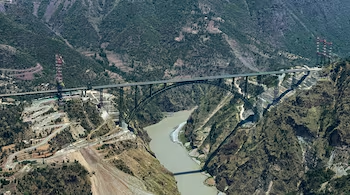
The Chenab Bridge, which stands 359 metres above the Chenab river, has become an attraction for locals and tourists alike. The Railways has built a viewing deck near the bridge’s main arch for visitors.
Both the Chenab and Anji Khad bridges were planned and developed by the Konkan Railway Corporation. The Chenab Bridge is the world’s highest railway arch bridge. Both bridges currently have a single track, as does most of the network, although they have provision for a second track. The Railways is planning additional passing loops along the section to increase capacity.