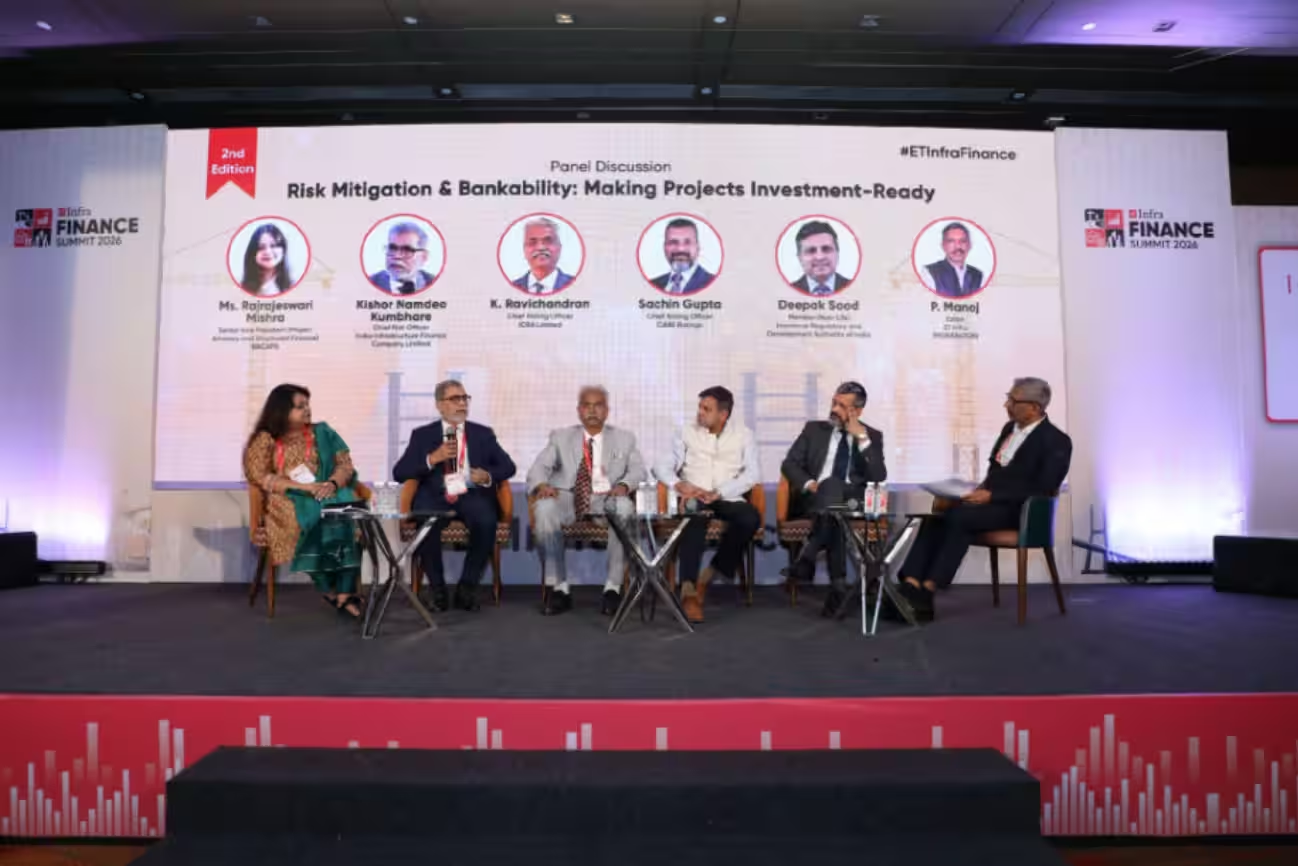
India’s infrastructure growth story will depend less on the availability of capital and more on the creation of consistently bankable projects capable of attracting private and institutional investment, industry leaders said at the ET Infra Finance Summit 2026, being organised in New Delhi.Speakers emphasised that balanced risk allocation, stronger project preparation and improved financing structures will be critical to building investor confidence across the infrastructure ecosystem.
Rajrajeswari Mishra, Senior Vice-President (Project Advisory and Structured Finance) at SBICAPS, said investor sentiment is improving, but project structures still place too much burden on developers and lenders. “The biggest missing thing, which we see, is a balanced risk allocation. It is entirely lying on the developers and debtors today,” she said. Mishra argued that private participation will deepen only when projects come with cleaner pre-development execution, including land acquisition, regulatory approvals and financing support structures already in place.“A pre-packaged deal with the government authority or multilaterals will attract further capital into the projects,” she added, pointing to staple financing and better front-end readiness as critical enablers.
From the lending and risk management side, Kishor Namdeo Kumbhare, Chief Risk Officer at India Infrastructure Finance Company Limited, said infrastructure financing now demands a far more structured approach than in the past. He noted that IIFCL has built differentiated frameworks for pre-construction and post-construction risk, backed by early warning systems, risk-based pricing and climate-focused assessment tools.“We have implemented an integrated risk management system… along with risk appetite statement, early warning signals and risk-based pricing,” he said. He also underlined that bankability still comes down to a few basic filters: “Land acquisition, regulatory approvals and certain cash flow” remain the three key readiness criteria lenders look for before backing a project.
Experts also highlighted how the insurance industry can become a bigger provider of long-term capital as solvency and risk-based capital frameworks evolve. Deepak Sood, Member (Non-Life), Insurance Regulatory and Development Authority of India, said insurance capital is particularly suited to operational infrastructure assets with stable cash flows. “What insurance really brings in is long-term investment capital,” he said, adding that this can help free up banks from long-duration exposures and improve overall capital efficiency in the system. Sood notes that better quality infrastructure assets will naturally become more attractive under a risk-based capital regime, even as new instruments such as surety bonds and partial credit support continue to mature.
Rating agencies argued that India’s infrastructure sector has already undergone a significant quality shift compared with the previous cycle. Sachin Gupta, Chief Rating Officer at CARE Ratings, said infrastructure is now one of the strongest segments within the corporate credit universe, helped by better project structuring, stronger counterparties and more disciplined appraisal.