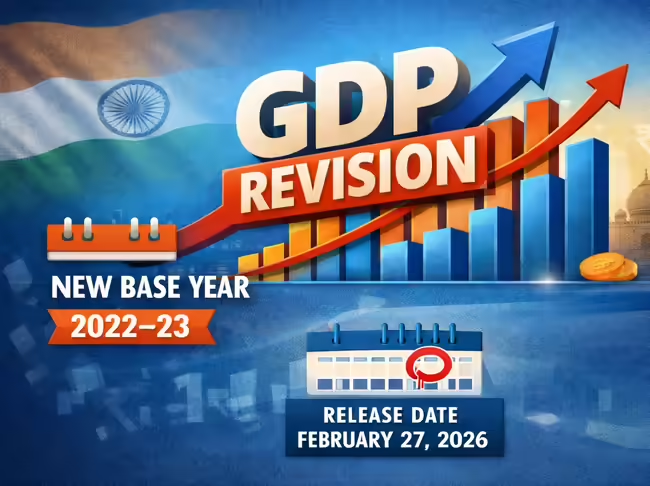
After inflation basket was rejigged earlier this month, India is now set to revise its Gross Domestic Product (GDP) math with 2022-23 as the new base year and also release back-series data for the previous few years, on February 27.
This, a part of a broader revision of economic statistics aimed at improving accuracy, will incorporate more granular indicators that better capture post-pandemic shifts in consumption and the rapid expansion of the digital economy.
Other economic data revisions: Earlier this month, the government released Consumer Price Index (CPI)-based inflation data for January, marking the first reading under the new CPI series with base year 2024.
The Ministry of Statistics and Programme Implementation (MoSPI) said the revision updates the inflation basket using the latest household consumption survey and fresh market data to better reflect current spending patterns and improve accuracy.
Similarly, the new Index of Industrial Production (IIP) series with base year 2022–23, a key measure of changes in industrial output, is slated for release on May 28, 2026, as part of efforts to update the data and keep it aligned with the revised national accounts framework.
Here’s a closer look at what is changing with the GDP, why the revisions are being undertaken, and how the new framework will take shape:
What is changing?
The government is overhauling how it measures GDP to better reflect India’s transformed economy.
The base year is being updated from 2011-12 to 2022-23 to capture new industries like digital services and renewable energy, shifts in consumption, and changes in investment patterns.
Methodological improvements are being introduced across sectors: manufacturing and services will now use more recent techniques to remove the impact of price changes, while the informal and gig economies will be better captured using surveys, GST data, and other high-frequency indicators.
Quarterly GDP estimates will also be improved with a new benchmarking method, the Proportional Denton method, which aligns quarterly numbers with annual totals without creating artificial jumps, ensuring that short-term economic trends are preserved.
Moreover, food subsidies, previously counted under product subsidies, will now be treated as transfers in kind. The new series will use net Goods and Services Tax (GST) collections, including cess, instead of gross GST and compensation cess, while state excise, union excise, sales tax, and Customs duty will be reflected using their respective actual values.
Overall, the revisions aim to make India’s GDP statistics more accurate, detailed, and representative of the real economy.
What will the new revisions capture?
At the heart of the overhaul is a shift to “double deflation”, a method that separately adjusts input and output prices to measure real value added more accurately. This is expected to improve estimates, especially in manufacturing, where differences between input and output prices had raised concerns about distortions under the earlier system.
The revisions will also better capture the gig and digital economy. While gig work was already included in GDP estimates, Garg said it will now be reflected more accurately using a wider range of indicators — including surveys of unincorporated enterprises, corporate filings and GST data — ensuring platform-based and self-employed workers are more fully represented.
Similarly, the informal sector will be measured with greater depth. More frequent and detailed surveys, such as those tracking employment patterns and household enterprises, along with high-frequency data like vehicle registrations and fuel consumption, are being used to plug data gaps.
Together, these changes aim to provide a more comprehensive and realistic picture of economic activity across both formal and informal segments.