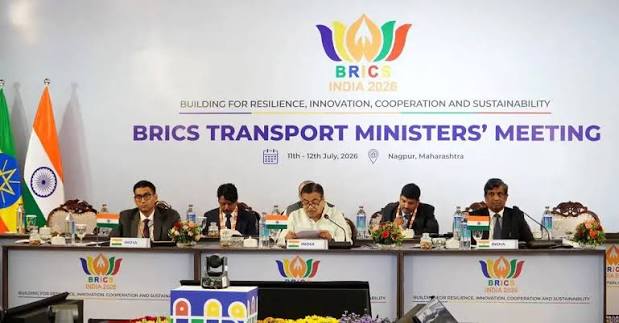
India’s union minister Nitin Gadkari advocated deeper BRICS collaboration for sustainable transport, highlighting India’s infrastructure innovations and urging joint solutions for shared mobility challenges.
With global mobility at a crossroads, India is making a strong case for BRICS nations to jointly reimagine the future of transportation. Union Minister for Road Transport and Highways, Nitin Gadkari, has called on the bloc to seize its collective influence and drive forward sustainable and resilient transport systems, positioning the group as a leader in shaping tomorrow’s mobility landscape.
Welcoming delegates from BRICS member countries to Nagpur, Gadkari used the occasion to underline India’s vision for its current chairship. This year’s theme, “Building for Resilience, Innovation, Cooperation and Sustainability,” is rooted in a people-centric philosophy inspired by the ancient Indian idea of ‘Vasudhaiva Kutumbakam,’ or the world as one family. According to an official release from the Ministry of Road Transport & Highways, this approach emphasizes human welfare, shared progress, and a commitment to future generations.
India’s rapid modernization across transportation sectors was highlighted as a model for fellow emerging economies. Gadkari outlined milestones such as the expansion of India’s road network, now the second largest globally, and the development of access-controlled expressways and multimodal corridors. Projects like the Delhi-Dehradun Economic Corridor and Sonamarg Tunnel, along with over 10,000 kilometers of new Greenfield Expressways, were cited as examples of blending innovation, efficiency, and sustainability.
Gadkari emphasized that safety and sustainability are central to India’s transport strategy. Notable initiatives include the PM Gati Shakti National Master Plan, which aims for integrated multimodal development and reduces logistics costs, and the PM-RAHAT scheme, providing cashless treatment for road accident victims. Environmentally conscious construction methods are being adopted, ranging from the use of recycled plastic, fly ash, and steel slag in road building to the installation of bamboo crash barriers and recycling end-of-life tyres.
BRICS: A platform for collective actionPointing to BRICS’ representation of nearly half the world’s population, Gadkari urged the bloc to take the lead in advancing cleaner, safer, and more inclusive transport systems. He identified common challenges—financing, congestion, emissions, road safety, and last-mile connectivity—that require united solutions.
India, he affirmed, stands ready to facilitate knowledge sharing, capacity building, and technological collaboration among BRICS countries. Areas of potential cooperation include green hydrogen, electric mobility, alternative fuels, digital transport solutions, and sustainable multimodal infrastructure.Opportunities and hurdles for global mobility
While BRICS nations share a vision for sustainable development, they also face complex hurdles such as securing investment, addressing urban congestion, and aligning standards for new technologies. India’s experience with large-scale infrastructure rollout and public-private partnerships may provide valuable lessons for the grouping.
Industry analysts note that as global supply chains evolve and climate priorities intensify, the willingness of BRICS to work together on mobility innovations could have far-reaching implications, not just for member states, but for developing economies worldwide.
Looking ahead: A call for joint progress
Gadkari expressed optimism that the outcomes of the Nagpur meeting would deepen ties and lead to practical, people-centric mobility solutions. He called on BRICS to build transport networks that promote inclusive growth, enhance regional connectivity, and deliver tangible environmental benefits. For India, the meeting reaffirmed its commitment to partnership and innovation as keys to a sustainable and prosperous transport future.
As the world searches for scalable answers to the twin challenges of development and decarbonization, India’s pitch for collaborative leadership within BRICS may set the tone for how emerging economies chart their own course in the global mobility revolution.