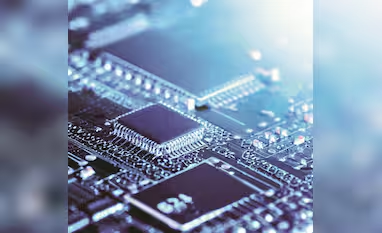
India’s push to build a domestic semiconductor industry is drawing interest from global chip companies, whose representatives highlighted the country’s manufacturing ambitions, engineering talent, and expanding technology ecosystem as opportunities for the global chip industry.
Speaking at Semicon India, being held from September 17 to 19, the executives pointed to artificial intelligence, data centres, power electronics, advanced packaging, and fabrication (fab) as areas where the country could play a larger role in the global semiconductor supply chain.
Wayne Allan, chief strategic sourcing and procurement officer at ASML, estimated that India’s semiconductor market could reach $110-120 billion by 2030, while stressing that meeting the country’s localisation ambitions would require multiple fabs and a much broader supporting ecosystem.
For ASML, the immediate opportunity is tied to Tata Electronics’ planned 300-millimetre (12-inch) semiconductor fab in Dholera, Gujarat, for which a strategic partnership was announced in May this year.
“We’re here to support that and make sure that Tata is successful, so many more fabs will be built in India. We believe that there’s a huge opportunity for India to be a big part of this growth and also to take its place as a semiconductor powerhouse,” Allan said. ASML expects Tata’s facility to be operational around 2028.
Highlighting confidence in India’s ambitions and progress in the semiconductor sector, Jochen Hanebeck, chief executive officer of Infineon Technologies, said the rapid expansion of data centres was creating demand not only for computing chips but also for technologies that generate, transmit, store, and efficiently deliver electricity.
In his keynote address, Hanebeck pointed to opportunities in renewable energy, battery storage, solid-state transformers, high-voltage direct current systems, and power conversion inside data centres. “There is no compute without power, and we take care from grid to core.”
Meanwhile, Srinivasan Iyengar, senior vice-president and general manager of Intel’s central engineering group, said the company had operated in India for more than four decades and saw the country’s engineering talent and startup ecosystem as important components of its future growth.
“The most important thing is a trusted partnership. With India at the forefront, and India going from what I would call good to great, that part of the journey is amazing, propelling through the vision of semiconductors and making semiconductors the new buzzword,” Iyengar said.