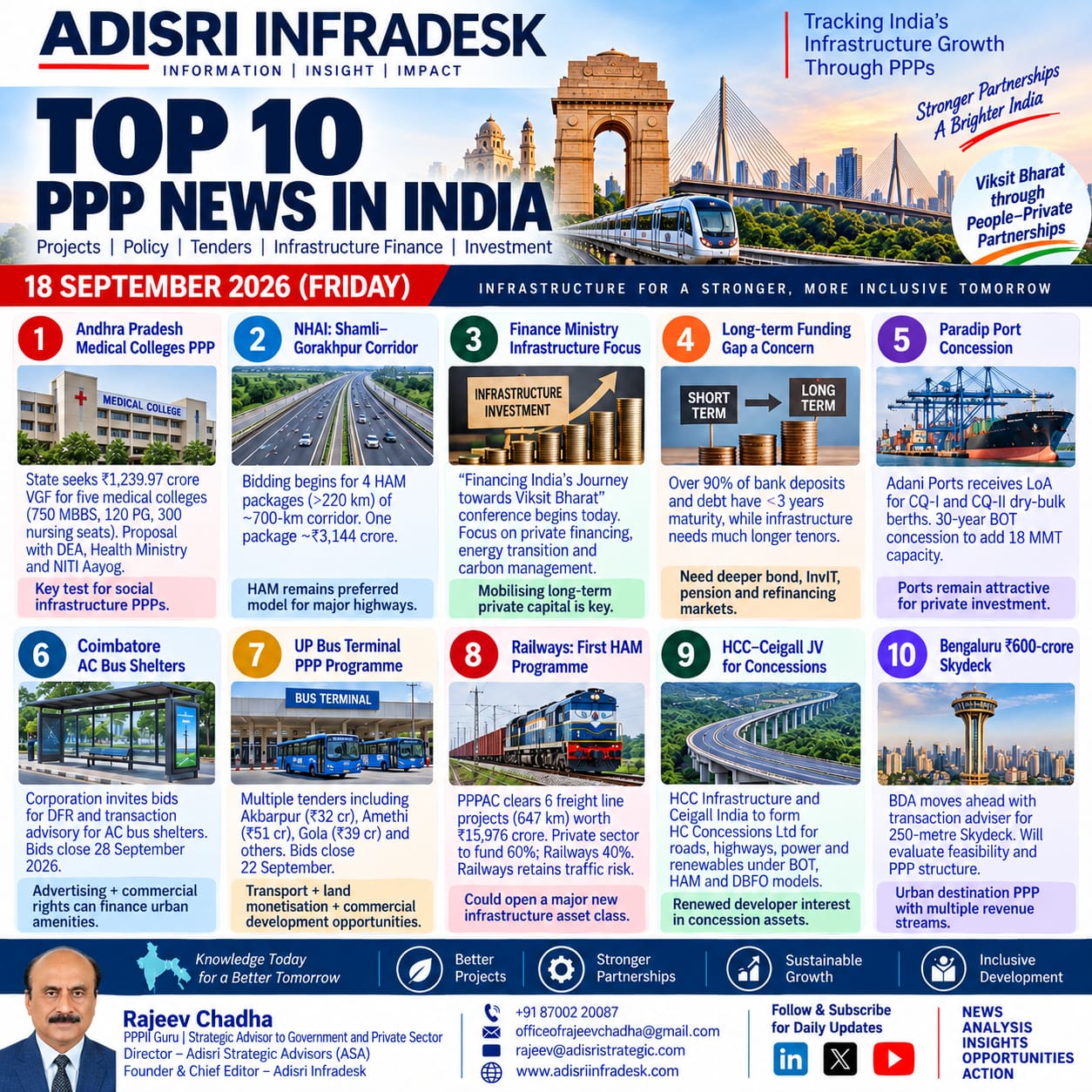
Public–Private Partnerships (PPPs) continue to emerge as a cornerstone of India’s infrastructure strategy, enabling governments to tap private sector capital, expertise and efficiency to bridge persistent infrastructure gaps.
The Economic Survey 2025–26 underlines that well-designed PPP frameworks are critical to improving service delivery across sectors such as roads, ports, power and urban infrastructure.
The Survey notes that the effectiveness of PPPs depends heavily on strong institutional mechanisms, predictable financial support and the use of standardised contractual frameworks.
On the global stage, India continues to rank among the top five destinations for private investment in infrastructure among low- and middle-income economies.
According to the World Bank’s Private Participation in Infrastructure Report 2024, the country accounted for more than 90 per cent of South Asia’s total private infrastructure investment.
Domestically, this momentum is reflected in a steady rise in project approvals by the Public–Private Partnership Appraisal Committee.
Following the Union Budget 2025–26, the government has drawn up a three-year PPP project pipeline comprising 852 projects across central ministries and States and Union Territories, with a combined value exceeding Rs 17 lakh crore.
In parallel, a dedicated PPP pipeline covering 13,400 km of projects worth an estimated Rs 8.3 lakh crore has been identified for development over the next three years, signalling a sustained push to crowd in private investment for India’s next phase of infrastructure growth.
As part of the privatisation and asset monetisation roadmap, the first public Infrastructure Investment Trust (InvIT) is planned for launch in 2026, building on the Rs 1.52 lakh crore already mobilised through Toll-Operate-Transfer projects and private InvITs.
India currently deploys a wide range of PPP models, including management contracts such as Build-Operate-Transfer (BOT), Design-Build-Finance-Operate-Transfer (DBFOT), the Hybrid Annuity Model (HAM) and Toll-Operate-Transfer (TOT).
Within the BOT structure, projects are executed either under a toll-based model or an annuity-based model, with the key difference being how traffic risk is allocated between the public and private partners.
Instruments such as the Model Request for Qualification (RfQ), Model Request for Proposal (RfP) and Model Concession Agreements (MCAs) have helped bring greater transparency, consistency and investor confidence to project execution.