The global economy faces an unprecedented transformation as nations scramble to secure control over the minerals that power modern technology. From smartphones to electric vehicles, renewable energy systems to defence applications, the race for lithium, rare earth elements, cobalt, and nickel has become a defining geopolitical challenge of the 21st century. For emerging economies like India, this mineral dependency represents both a strategic vulnerability and an extraordinary opportunity to reshape domestic industrial capacity through innovative public private partnership in mining sector India frameworks.
Traditional procurement models have left many nations exposed to supply chain disruptions and price volatility in critical mineral markets. Furthermore, as demand for clean energy technologies accelerates, countries that once relied purely on imports are now exploring hybrid approaches that combine government strategic planning with private sector expertise and capital. This shift toward collaborative frameworks represents a fundamental reimagining of how nations can achieve resource security while building sustainable domestic industries, particularly through mining sector evolution.
Understanding India’s Strategic Mineral Vulnerability
India’s position in the global critical minerals landscape reflects a complex paradox of geological potential constrained by limited exploration infrastructure. The nation possesses documented reserves across multiple strategic elements, yet remains heavily dependent on imports to meet growing industrial demand. This dependency extends across lithium for battery manufacturing, rare earth elements for electronics and defence applications, cobalt and nickel for electric vehicle production, and copper for renewable energy infrastructure.
The economic implications of this import reliance create cascading effects throughout India’s industrial ecosystem. In addition, rising global commodity prices directly impact manufacturing costs for domestic producers, while supply chain uncertainties from geopolitical tensions create operational risks for industries dependent on consistent mineral flows. The electronics sector, defence manufacturing, and emerging electric vehicle industry face particular vulnerabilities when international suppliers implement export restrictions or prioritise shipments to other markets.
Recent analysis indicates that India’s mineral import expenditure has grown substantially across key strategic elements. Lithium imports alone represent a growing portion of the nation’s mineral trade balance, as domestic battery manufacturing capacity expands to meet electric vehicle production targets. Similarly, rare earth element imports continue increasing despite the presence of untapped domestic reserves in states with established mining infrastructure. This situation aligns closely with India’s lithium strategy for securing supply chains.
The geographic distribution of India’s critical mineral potential spans multiple regions with varying levels of exploration maturity. Coal-bearing states like Telangana and Odisha have demonstrated unexpected secondary mineral recovery opportunities, while traditional mining regions possess unexplored potential for lithium and rare earth extraction. However, the gap between geological potential and operational capacity reflects broader challenges in exploration financing, environmental compliance, and technical expertise deployment.
Supply chain resilience concerns extend beyond simple import substitution to encompass processing and refining capabilities. Consequently, many critical minerals require sophisticated separation and purification technologies that currently exist primarily in China and other established producers. This processing bottleneck means that even successful domestic extraction may still require international partnerships for value-added conversion into industrial inputs.
What Role Does NITI Aayog’s Framework Play in Mining Sector Transformation?
The establishment of India’s National Critical and Strategic Minerals Committee under NITI Aayog represents a coordinated institutional response to mineral security challenges. This framework operates through multi-agency coordination mechanisms that bring together central government planning bodies, state mining departments, public sector enterprises, and private industry representatives to develop comprehensive resource strategies.
The committee’s operational structure emphasises time-bound action planning with specific deliverables for policy formulation and implementation oversight. Under the leadership of D K Singh as chairman and R Saravanabhavan as Deputy Advisor for Minerals and Member Secretary, the body conducts regular assessments of demand-supply scenarios, exploration opportunities, technological requirements, and policy support mechanisms across participating states and organisations.
Key institutional coordination mechanisms include:
• Multi-ministerial collaboration across mining, environment, and industrial development portfolios
• State government integration through revenue sharing and infrastructure development agreements
• Performance monitoring systems linking exploration targets to policy support access
• Technology transfer facilitation between international partners and domestic enterprises
• Regulatory harmonisation to streamline environmental and operational approvals
The framework’s approach to investment blueprint development involves systematic evaluation of mineral potential across geographic regions and commodity types. While specific financial commitments require verification through official government publications, the committee’s mandate encompasses strategic planning for exploration, extraction, processing, and downstream industrial integration across seven-year implementation cycles.
Public sector enterprise participation forms a cornerstone of the framework’s operational strategy. Companies like Singareni Collieries Company Limited have demonstrated innovative approaches to rare earth element extraction from coal mine overburden and thermal power plant waste streams. This indicates potential for integrated resource recovery within existing industrial operations, particularly when combined with AI in mining technology advances.
Committee discussions have addressed several critical operational areas:
• Current demand projections for strategic minerals across renewable energy, electric vehicles, electronics, defence, and advanced manufacturing
• State-wise exploration opportunity assessments with infrastructure requirement analysis
• Policy support mechanism design including incentive structures and regulatory streamlining
• Government agency coordination protocols for project approval and monitoring processes
The next phase of framework implementation involves detailed assessment visits to public sector enterprises, with meetings scheduled at facilities like NLC India Limited to evaluate operational integration opportunities. This hands-on approach suggests the committee’s focus extends beyond policy formulation to practical implementation support for participating organisations.
Which Critical Minerals Offer the Greatest PPP Opportunities in India?
The strategic prioritisation of critical minerals for public private partnership in mining sector India development reflects both domestic geological potential and industrial demand projections. Lithium emerges as the highest-priority element given India’s ambitious electric vehicle adoption targets and growing battery manufacturing sector investments. Domestic lithium reserves, while requiring advanced extraction technologies, could support substantial portions of projected battery industry requirements through coordinated exploration and processing facility development.
Rare earth elements present unique PPP opportunities through their diverse industrial applications and existing extraction capabilities demonstrated by companies like SCCL. The integration of rare earth recovery into existing coal mining operations creates cost-effective production models that leverage established infrastructure and regulatory approvals. This dual-commodity approach reduces exploration risks while creating additional revenue streams for traditional mining enterprises.
The cobalt and nickel sector offers significant partnership potential given their critical importance for electric vehicle battery chemistry and stainless steel production. Furthermore, India’s projected EV market growth creates substantial domestic demand for these elements, while existing metallurgical industry infrastructure provides processing capability foundations that private partners can expand and modernise through technology transfer agreements.
Geological potential assessment reveals varying opportunity levels across states:
• Rajasthan and Gujarat: Lithium-bearing pegmatite deposits requiring specialised extraction technologies
• Odisha and Jharkhand: Nickel laterite deposits with established mining infrastructure proximity
• Telangana and Chhattisgarh: Rare earth elements in coal overburden and clay formations
• Karnataka and Tamil Nadu: Graphite deposits supporting renewable energy infrastructure development
Graphite and copper represent additional partnership opportunities driven by renewable energy infrastructure expansion and electrical grid modernisation requirements. Natural graphite deposits in South Indian states could support domestic battery anode production, while copper demand for solar installations, wind turbines, and grid connections creates sustained market opportunities for extraction and processing partnerships.
Technology gaps requiring international partnership include:
• Lithium extraction from hard rock deposits using efficient processing methods
• Rare earth element separation and purification for high-grade industrial applications
• Cobalt and nickel recovery from low-grade laterite and sulphide formations
• Advanced graphite processing for battery-grade material production
The competitive advantage for PPP development stems from combining India’s geological resources with international technical expertise and capital deployment capability. Private partners bring specialised extraction technologies, processing equipment, and market access, while public sector participation provides regulatory navigation, long-term strategic alignment, and patient capital deployment for extended development timelines.
Infrastructure development requirements for remote mining locations create additional PPP opportunities in transportation, power supply, water management, and community development. These ancillary projects often require substantial upfront investments that benefit from risk-sharing arrangements between public and private partners, particularly in regions where mining operations can catalyse broader economic development.
How Do International Partnership Models Enhance Domestic Mining Capacity?
International collaboration frameworks for critical mineral development operate through multiple partnership structures designed to combine India’s geological resources with global technical expertise and financial capacity. These models range from bilateral government agreements to private sector joint ventures, each offering distinct advantages for different mineral commodities and development stages. However, successful implementation requires understanding of mining claims framework principles adapted for Indian conditions.
Technology transfer protocols represent a fundamental component of international partnership success, particularly for minerals requiring specialised extraction and processing capabilities. Foreign partners typically provide advanced mining equipment, separation technologies, and processing methodologies that domestic companies can adapt for local geological conditions. This knowledge sharing extends beyond equipment supply to encompass operational training, environmental management practices, and quality control systems.
Joint exploration frameworks enable risk sharing during the uncertainty-intensive early stages of mineral development projects. International mining companies bring geological assessment capabilities, exploration financing, and regulatory experience from multiple jurisdictions, while Indian partners provide local knowledge, government relationship management, and domestic market access. This combination reduces exploration costs and accelerates timeline completion for resource assessment and feasibility studies.
Investment flow structures typically involve multiple financing stages:
• Phase 1: Exploration and geological assessment with shared cost arrangements
• Phase 2: Development infrastructure and processing facility construction
• Phase 3: Production scaling and market development with revenue sharing protocols
• Phase 4: Technology upgrade and expansion financing for capacity growth
Knowledge sharing mechanisms extend beyond technical capabilities to encompass regulatory compliance, environmental management, and community engagement practices. International partners often possess experience navigating complex permitting processes, stakeholder consultation requirements, and sustainability certification standards that Indian companies can adapt for domestic applications. Moreover, these frameworks maintain global market access for processed mineral products, similar to US Exim loan insights for strategic resource development.
The strategic advantage of international partnerships lies in their ability to compress development timelines through parallel capability building across technical, financial, and operational dimensions. Rather than sequential domestic capability development, partnership models enable simultaneous technology transfer, infrastructure construction, and market development that accelerates overall project implementation and reduces competitive disadvantages relative to established global producers.
Risk mitigation provisions in international partnerships typically address:
• Currency exchange rate fluctuations affecting equipment imports and revenue streams
• Regulatory changes impacting mining rights, environmental requirements, or export policies
• Market price volatility for processed mineral products in global commodity markets
• Technical performance guarantees for extraction efficiency and processing quality standards
What Financial Mechanisms Enable Successful Mining PPPs?
The architecture of mining PPP financing reflects the unique risk profiles and capital requirements of critical mineral projects, which typically involve high upfront exploration costs, extended development timelines, and uncertain market conditions. Government-backed financing solutions play a crucial role in reducing private sector investment risks while maintaining commercial viability for partnership structures.
Export-Import Bank participation in mining PPP projects provides concessional financing for equipment imports, technology acquisition, and overseas partnership development. These programmes typically offer below-market interest rates and extended repayment periods that align with mining project cash flow profiles. In addition, they maintain performance requirements linked to domestic mineral production targets and employment generation objectives.
Performance-based grant structures create incentive alignment between public policy objectives and private sector operational efficiency. These mechanisms tie government financial support to specific performance metrics including production volume targets, domestic value addition levels, employment creation benchmarks, and technology transfer achievement milestones. This approach ensures public investment generates measurable strategic benefits while maintaining commercial incentives for operational excellence.
| Financing Model | Government Share | Private Share | Risk Distribution | Typical Project Size |
|---|---|---|---|---|
| Joint Venture | 40-60% | 40-60% | Shared exploration/operational | $500M-2B |
| Development Operator | 20-30% | 70-80% | Private operational risk | $200M-1B |
| Royalty-Based Financing | 100% upfront | Repayment via royalties | Government exploration risk | $50M-500M |
Royalty-linked repayment structures align government financial contributions with actual mineral production and market performance, reducing private sector fixed obligation risks while ensuring public investment recovery through successful project outcomes. These arrangements typically involve government funding for exploration and early development phases, with repayment calculated as percentage of gross revenue or production volume over specified periods.
Concessional loan programmes for exploration and development phases address the specific capital intensity challenges of mining projects, where substantial investments precede revenue generation by several years. These programmes often feature grace periods during exploration and construction phases, followed by repayment schedules aligned with production ramp-up timelines and market price cycles. Furthermore, the success of these models can be observed through various international examples of structured financing approaches.
Risk allocation mechanisms across PPP structures include:
• Exploration Risk: Typically shared through joint funding with performance milestones
• Development Risk: Private sector responsibility with government infrastructure support
• Market Risk: Shared through minimum price guarantees or revenue stabilisation funds
• Regulatory Risk: Government responsibility with change-in-law compensation provisions
Currency risk management provisions address the international nature of mining equipment procurement and potential export market exposure for processed minerals. These mechanisms may include government foreign exchange hedging support, local content requirements to reduce import dependency, or revenue sharing arrangements that provide natural currency hedging through domestic market sales.
Collateral and security arrangements for mining PPPs often involve mineral reserves as underlying assets, combined with government guarantees for debt service during production phases. This approach provides lenders with tangible asset security while enabling private partners to leverage government credit worthiness for improved financing terms and extended repayment periods.
How Can Public Sector Enterprises Drive Strategic Mineral Security?
Public sector enterprises occupy a unique position in India’s critical mineral development strategy, combining long-term strategic perspective with operational capabilities and government policy alignment. Their advantages in regulatory risk navigation stem from established relationships with central and state government agencies, enabling more efficient permitting processes and policy compliance management compared to private sector entrants facing regulatory uncertainty.
The patient capital deployment capability of PSUs enables sustained investment in exploration and development projects with extended payback periods that may discourage private investors focused on shorter-term returns. This long-term orientation aligns with critical mineral projects’ typical development cycles, where geological assessment, environmental approvals, and infrastructure construction may require 5-7 years before commercial production begins.
Singareni Collieries Company Limited exemplifies innovative PSU approaches to critical mineral development through integrated resource recovery from existing operations. The company’s extraction of rare earth elements from coal mine overburden and clay formations demonstrates how traditional mining enterprises can expand into strategic mineral production without entirely new project development. This model reduces exploration risks while leveraging established infrastructure, regulatory approvals, and operational expertise.
The integration of mineral recovery from thermal power plant waste streams represents another PSU innovation that creates value from previously discarded materials. SCCL’s recovery of valuable minerals from fly ash and bottom ash at Singareni Thermal Power Plant demonstrates circular economy principles while generating additional revenue streams that improve overall project economics for critical mineral production.
Strategic alignment with national security objectives enables PSU participation in projects that may offer limited commercial attractiveness but significant strategic value for domestic supply chain security. This capability proves particularly important for defence-related mineral requirements or processing capabilities that private companies might avoid due to market size limitations or security clearance requirements.
Case study analysis reveals several PSU success models:
• Madhya Pradesh State Mining Corporation: Joint venture structures combining state government resources with private technical expertise
• Steel Authority of India Limited: Partnership frameworks leveraging metallurgical expertise for critical mineral processing
• National Mineral Development Corporation: Exploration and development capabilities applicable to strategic mineral commodities
The coal sector PSU experience provides valuable precedents for critical mineral PPP development, including revenue sharing mechanisms, environmental management systems, community engagement protocols, and integration with existing industrial operations. These established frameworks can be adapted for lithium, rare earth, cobalt, and nickel projects while maintaining operational efficiency and regulatory compliance standards.
PSU competitive advantages in mining partnerships include:
• Established Infrastructure: Existing mining equipment, transportation systems, and processing facilities that reduce development costs
• Regulatory Expertise: Experience navigating complex environmental and safety approval processes
• Community Relations: Established relationships with local communities and stakeholder management systems
• Technical Capabilities: Mining engineering expertise applicable across multiple mineral commodities
The expansion of PSU operations into critical mineral development often involves technology partnerships with international companies that provide specialised extraction and processing capabilities. These arrangements enable PSUs to maintain operational control while accessing advanced technologies necessary for competitive production in global mineral markets.
What Technology Integration Strategies Maximise PPP Effectiveness?
Technology integration represents the critical bridge between India’s geological potential and commercially viable critical mineral production, requiring sophisticated approaches that combine domestic operational capabilities with international technical expertise. Advanced extraction technologies for lithium recovery from hard rock deposits demand specialised crushing, grinding, and flotation systems that few domestic companies currently possess, creating opportunities for technology transfer partnerships with established global producers.
Environmental compliance solutions for sustainable mining operations increasingly determine project viability through both regulatory requirements and market access considerations. Modern critical mineral extraction requires real-time environmental monitoring systems, water treatment technologies, and waste management protocols that minimise ecological impact while maintaining production efficiency. These systems often involve proprietary technologies that international partners can provide through licensing agreements or joint development programmes.
Automation and digitalisation needs for operational efficiency encompass multiple technological domains including remote sensing for geological assessment, automated mining equipment for safety and productivity improvement, and integrated processing control systems for quality optimisation. The integration of these technologies requires substantial capital investment and specialised technical expertise that public private partnership in mining sector India structures can effectively deploy through risk-sharing arrangements.
Innovation requirements across critical mineral processing include:
• Lithium Extraction: Advanced brine processing and hard rock beneficiation technologies
• Rare Earth Separation: Sophisticated chemical separation processes for individual element isolation
• Cobalt Recovery: Hydrometallurgical processing systems for low-grade ore treatment
• Nickel Processing: High-pressure acid leach and electrowinning technologies for laterite deposits
Research and development collaboration models between universities, industry, and government create institutional frameworks for indigenous capability development while reducing dependency on foreign technology providers. These triple helix partnerships enable fundamental research on Indian geological conditions, adaptation of international technologies for local applications, and training of technical personnel capable of operating advanced mineral processing systems. Consequently, these collaborations support catalysing public capital initiatives for the sector.
Technology transfer agreements with international mining companies typically involve multiple components including equipment supply, technical training, process optimisation support, and ongoing maintenance services. These comprehensive arrangements ensure sustainable technology deployment while building domestic technical capabilities that reduce long-term dependency on foreign technical support.
The development of indigenous technical capabilities requires systematic investment in education, training, and research infrastructure that supports critical mineral technology development. This includes specialised mining engineering programmes, materials science research capabilities, and testing facilities that enable verification of processing efficiency and product quality standards required for domestic and international market access.
Key technology integration success factors include:
• Phased Implementation: Gradual technology deployment with performance validation at each stage
• Local Adaptation: Modification of international technologies for Indian geological and operational conditions
• Skills Development: Comprehensive training programmes for technical personnel and maintenance teams
• Continuous Improvement: Ongoing research and development for process optimisation and cost reduction
How Do Regulatory Reforms Support PPP Implementation?
Regulatory harmonisation across multiple government ministries represents a fundamental requirement for successful critical mineral PPP implementation, addressing the complex intersection of mining regulations, environmental compliance, industrial policy, and foreign investment approvals. Policy coordination mechanisms between the Ministry of Mines, Ministry of Environment and Forests, Ministry of Commerce and Industry, and state governments eliminate conflicting requirements that historically delayed project approvals and increased compliance costs.
Environmental clearance streamlining for strategic mineral projects involves development of expedited approval processes that maintain environmental protection standards while reducing timeline uncertainty for investors. These mechanisms include consolidated environmental impact assessments covering multiple project phases, standardised mitigation measures for common mining impacts, and pre-approved environmental management plans for established geological formations.
Land acquisition reforms for mining infrastructure development address one of the most significant obstacles to large-scale mineral project implementation. Streamlined land acquisition procedures for strategic mineral projects include standardised compensation frameworks, accelerated consent processes for industrial use conversion, and coordination between central and state authorities for project area designation and approval management.
Taxation incentives for critical mineral exploration and processing create financial advantages that improve project economics while encouraging private sector participation in strategically important but commercially challenging mineral development. These incentives may include accelerated depreciation for specialised mining equipment, reduced customs duties for critical mineral processing technologies, and performance-based tax reductions linked to domestic production targets.
State government coordination mechanisms establish clear frameworks for revenue sharing, infrastructure development responsibilities, and local community benefit programmes that align state and central government incentives for project success. These coordination structures include:
• Revenue Sharing Protocols: Clear division of royalties, taxes, and other revenue streams between central and state governments
• Infrastructure Responsibility Matrix: Defined obligations for road, power, water, and telecommunications infrastructure development
• Community Benefit Programmes: Standardised approaches to local employment, skill development, and social development contributions
Regulatory reform priorities for PPP success include:
• Single Window Clearances: Consolidated approval processes reducing bureaucratic complexity and timeline uncertainty
• Performance-Based Compliance: Regulatory frameworks emphasising operational outcomes rather than procedural requirements
• International Standard Alignment: Harmonisation with global best practices for environmental management and safety standards
• Dispute Resolution Mechanisms: Clear procedures for addressing regulatory conflicts and project modification requirements
Foreign investment policy modifications for strategic mineral projects recognise the technical expertise and capital requirements that international partnerships provide while maintaining appropriate oversight for national security considerations. These policy frameworks include sector-specific FDI guidelines, security clearance procedures for foreign technical personnel, and technology transfer monitoring systems. Furthermore, these modifications support public-private partnerships across various sectors.
The development of regulatory sandboxes for innovative mining technologies enables testing and validation of new extraction and processing methods without full regulatory compliance during pilot phases. This approach encourages technological innovation while maintaining environmental protection and safety standards through controlled testing environments and performance monitoring requirements.
What Are the Economic Multiplier Effects of Mining PPPs?
The economic impact analysis of critical mineral PPPs extends far beyond direct mining operations to encompass comprehensive industrial ecosystem development, employment generation, and trade balance improvement through import substitution and export potential creation. Direct employment generation across skilled and semi-skilled categories reflects both mining operations and downstream processing activities, with typical large-scale critical mineral projects creating 2,000-5,000 direct jobs during operational phases.
Industrial ecosystem development around processing facilities creates substantial indirect economic benefits through supplier industries, logistics services, maintenance and repair operations, and supporting professional services. These multiplier effects typically generate 3-5 indirect jobs for each direct mining position, while creating demand for specialised equipment manufacturing, chemical processing supplies, and technical services that can develop into independent industrial clusters.
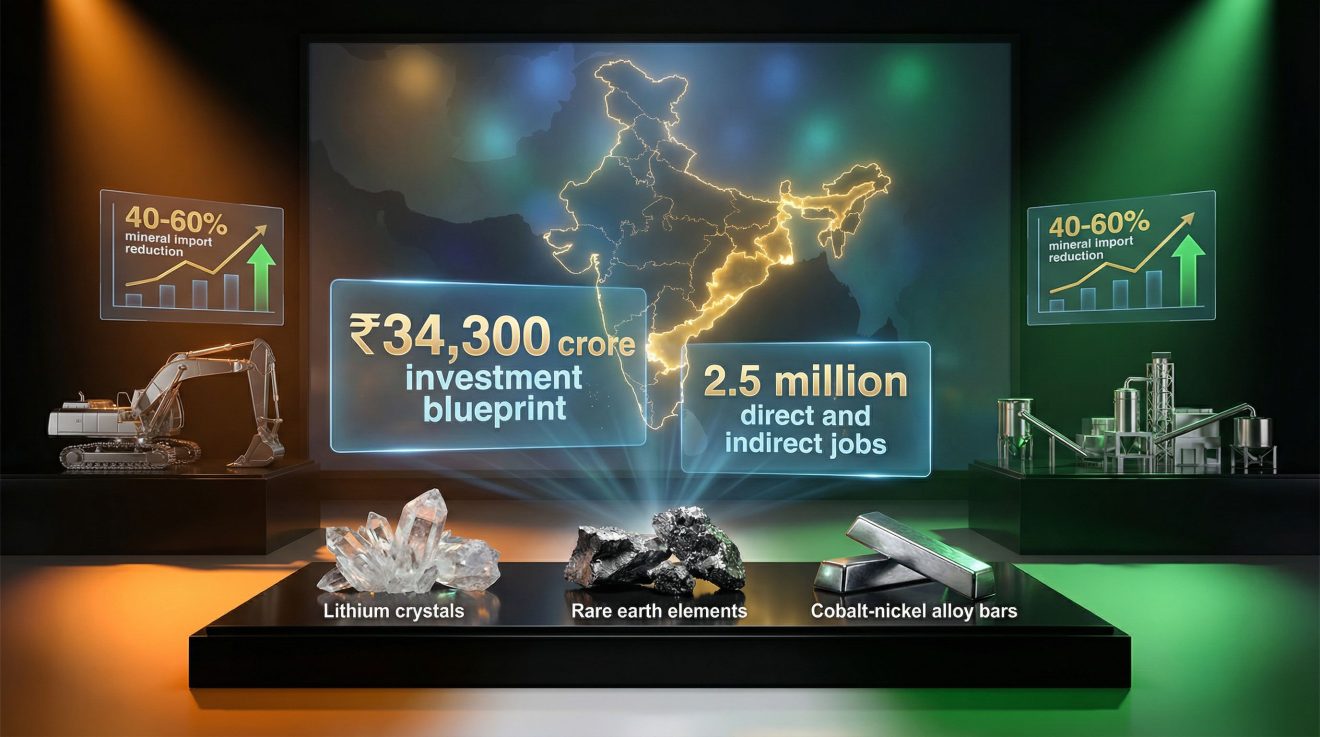
Critical mineral PPPs could potentially reduce India’s strategic mineral import dependency by 40-60% across key elements while generating cumulative economic impacts of ₹8-12 lakh crore through integrated downstream industrial development over the next decade, creating sustainable competitive advantages in clean energy technology manufacturing and export markets.
Export potential development creates foreign exchange earning opportunities that improve national trade balances while establishing India as a reliable supplier in global critical mineral markets. Processed lithium compounds, rare earth element products, and battery-grade materials command premium prices in international markets compared to raw mineral exports, creating substantial value addition opportunities for PPP operations.
The downstream industrial development encompasses battery manufacturing ecosystems, renewable energy component production, electronics manufacturing expansion, and defence industry supply chain strengthening. These integrated industrial clusters create competitive advantages that attract additional foreign investment while reducing dependency on imported finished products across multiple strategic sectors.
Quantified economic impact projections include:
• Employment Generation: 2.5 million direct and indirect jobs across mining, processing, and downstream manufacturing over ten-year development period
• Import Substitution Value: ₹2-3 lakh crore annual reduction in critical mineral import requirements at full operational capacity
• Export Revenue Potential: ₹1.5-2 lakh crore annual export earnings from processed mineral products and value-added materials
• Industrial Investment Attraction: ₹5-8 lakh crore additional foreign and domestic investment in downstream manufacturing industries
Regional economic development benefits concentrate in mineral-rich states but extend through supply chain integration and transportation infrastructure development. Mining regions typically experience substantial improvements in local infrastructure including road networks, power supply reliability, telecommunications connectivity, and educational facility development that support broader economic growth beyond mining operations.
Technology transfer economic benefits include the development of indigenous technical capabilities, intellectual property creation, and specialised service industry development that creates sustainable competitive advantages beyond individual mining projects. These capabilities enable future expansion into additional mineral commodities and international consulting services for other developing nations pursuing critical mineral independence. Moreover, NITI Aayog’s recommendations support this strategic direction.
The strategic autonomy enhancement through domestic critical mineral production creates immeasurable economic value through reduced supply chain vulnerability, price stability for domestic industries, and strategic flexibility in international trade relationships. This strategic independence enables more favourable negotiating positions in bilateral trade agreements and reduces susceptibility to supply chain disruptions from geopolitical tensions.
How Can India Scale PPP Models for Global Competitiveness?
International best practices integration from established mining jurisdictions provides proven frameworks that India can adapt for critical mineral PPP development while avoiding common implementation challenges. Australian mining PPP frameworks offer particularly relevant models for resource security given similar federal government structures, environmental regulatory requirements, and private sector partnership approaches that balance commercial viability with strategic resource objectives.
Canadian joint venture models demonstrate effective approaches to indigenous community participation and environmental stewardship that align with India’s community engagement requirements and sustainability commitments. These frameworks include comprehensive benefit-sharing agreements, local employment targets, and community development programmes that create sustainable social licence for mining operations while maintaining operational efficiency.
Chilean lithium extraction partnerships provide technical and commercial precedents for PPP structures in strategic mineral development, particularly regarding royalty arrangements, technology transfer protocols, and international market development strategies. Chile’s experience balancing domestic resource control with international partnership benefits offers valuable insights for India’s lithium development planning.
Future expansion opportunities through international partnership development include African mineral resource collaboration, Central Asian rare earth partnerships, and Southeast Asian processing facility joint ventures that create regional supply chain networks. These international expansion models enable Indian companies to secure diversified mineral supplies while developing technical capabilities and market access that strengthen domestic operations.
African mineral resource partnerships through development finance institutions create opportunities for Indian companies to gain international mining experience while securing long-term supply agreements for critical minerals. These partnerships typically involve Indian technical expertise and financing combined with African geological resources and regional market access, creating mutually beneficial development relationships.
Central Asian rare earth collaboration through regional connectivity projects leverages India’s infrastructure development capabilities and strategic relationships to secure access to significant rare earth deposits. These partnerships align with broader regional integration objectives while providing alternative supply sources that reduce dependency on dominant global producers.
Southeast Asian processing facility joint ventures create regional supply chain networks that combine Indian technical capabilities with regional market access and logistics advantages. These partnerships enable development of specialised processing facilities serving multiple national markets while creating economies of scale that improve overall competitive positioning. These approaches align with India-Australia engagement strategies.
Scaling strategies for global competitiveness include:
• Technology Leadership Development: Investment in research and development for next-generation mining and processing technologies
• Regional Hub Strategy: Positioning India as South Asian centre for critical mineral processing and trading
• International Standard Compliance: Alignment with global environmental, social, and governance standards for market access
• Strategic Partnership Portfolio: Diversified international relationships reducing dependency on single-country partnerships
The development of India’s critical mineral PPP models as exportable frameworks creates opportunities for technical consulting services, equipment exports, and project management services in other developing nations pursuing similar resource security objectives. This export potential for PPP expertise creates additional economic value while strengthening India’s position in global mineral development networks.
Enjoyed this article?
We publish high-impact stories like this a few times a week. No spam.
What Success Metrics Define Effective Mining PPPs?
Quantitative performance indicators for mining PPP success encompass production volume achievements, investment realisation rates, timeline adherence, and technology transfer success measured through tangible capability development metrics. Production volume targets must align with domestic demand projections and import substitution objectives while maintaining commercial viability for private sector partners through market-competitive production costs and quality standards.
Investment realisation tracking requires comprehensive monitoring of capital deployment across exploration, development, and operational phases with performance benchmarks tied to specific project milestones. These metrics include actual capital expenditure versus planned investment schedules, private sector financial contribution verification, and public sector resource allocation efficiency measurement through cost-per-ton production comparisons.
Technology transfer success measurement extends beyond equipment installation to encompass indigenous capability development through patent applications, technical personnel training completion, and operational independence achievement. Successful technology transfer results in reduced dependency on foreign technical support, domestic equipment maintenance capabilities, and adaptation of international technologies for local geological conditions.
Timeline adherence measurement requires sophisticated project management systems that track critical path activities across exploration completion, environmental approvals, infrastructure development, and production ramp-up phases. These systems must account for regulatory approval variations, community consultation requirements, and technical challenges while maintaining accountability for overall project delivery schedules.
Qualitative assessment frameworks evaluate environmental sustainability compliance, community development impact, and strategic autonomy enhancement through comprehensive stakeholder feedback systems and long-term impact measurement protocols. Environmental compliance measurement includes real-time monitoring data, ecosystem impact assessments, and restoration success metrics that ensure sustainable operations throughout project lifecycles.
Community development impact assessment encompasses employment generation quality, local skill development programme effectiveness, infrastructure improvement benefits, and social licence maintenance through ongoing stakeholder engagement. These qualitative measures ensure that mining PPPs create sustainable positive impacts for local communities while maintaining operational efficiency and regulatory compliance.
Strategic autonomy enhancement measurement includes:
• Import Dependency Reduction: Quantified decreases in critical mineral import requirements across targeted commodities
• Supply Chain Resilience: Diversification of supply sources and reduced vulnerability to international market disruptions
• Industrial Capacity Development: Downstream processing capabilities and value-added manufacturing expansion
• Technical Capability Growth: Indigenous expertise development and reduced dependency on foreign technical support
Performance monitoring systems require:
• Real-Time Data Collection: Automated systems for production, environmental, and safety performance tracking
• Stakeholder Reporting: Regular communication with government agencies, communities, and private partners
• Adaptive Management: Flexible frameworks for adjusting performance targets based on market conditions and operational experience
• Continuous Improvement: Systematic evaluation and optimisation of operational processes and partnership structures
Success metric integration across multiple stakeholder perspectives ensures that public private partnership in mining sector India performance measurement captures public policy objectives, private sector commercial requirements, community development benefits, and environmental sustainability goals through balanced scorecard approaches. This prevents optimisation of single metrics at the expense of overall project success.
The establishment of industry benchmarking systems enables comparative performance assessment across different PPP projects and partnership structures, creating competitive incentives for operational excellence while identifying best practices that can be replicated across the broader critical mineral development sector.
The analysis and projections contained in this article reflect current policy frameworks and market conditions, which may change significantly based on technological developments, regulatory modifications, and international market dynamics. Investment decisions should be based on comprehensive due diligence and professional financial advice rather than the speculative elements discussed herein.
Looking to Invest in India’s Critical Mineral Revolution?
Discovery Alert’s proprietary Discovery IQ model delivers instant notifications on significant ASX mineral discoveries, enabling investors to capitalise on breakthrough opportunities in companies with Indian partnerships and critical mineral exposure. Explore historic examples of exceptional returns from major mineral discoveries by visiting Discovery Alert’s dedicated discoveries page, then begin your 14-day free trial to position yourself ahead of the market in this transformative sector.