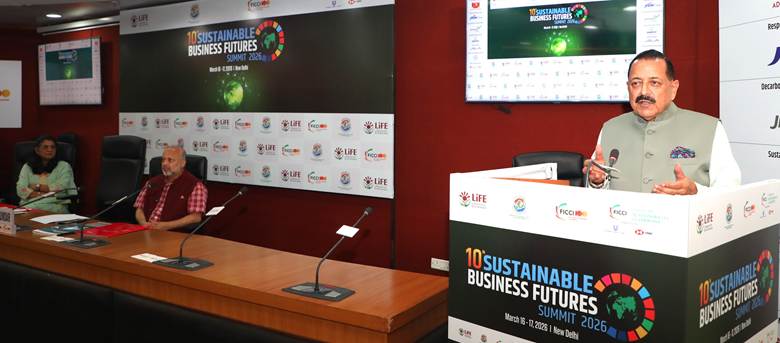
India, with its population of 1.4 billion, holds a decisive role in the global transition towards a greener future, Union Minister Dr Jitendra Singh said on Tuesday, highlighting that green infrastructure will be central to the country’s future economic growth.
Addressing the 10th Sustainable Business Futures Summit 2026, the Minister said India’s scale presents both a responsibility and an opportunity to emerge as a major global driver of sustainable development powered by green technologies and clean energy systems.
He noted that India’s progress will significantly influence the success of the global green transition and said the country is aligning its development pathway with emerging priorities such as recycling, regeneration, and environmentally sustainable technologies.
Dr Singh said India’s economic transformation over the past decade has been supported by a rapidly expanding innovation ecosystem. He pointed out that the country now has over two lakh startups, with nearly half emerging from Tier-II and Tier-III cities, reflecting a broader shift in entrepreneurial activity.
Highlighting the need for reliable and clean energy, particularly for emerging sectors like data centres and artificial intelligence, the Minister referred to the SHANTI Act (Sustainable Harnessing and Accelerating Nuclear Transformation of India) as a landmark reform. He said the Act opens up the nuclear energy sector for wider participation, including private players, and enables new avenues for clean and dependable energy generation.
He further said India’s green transition strategy integrates technological innovation, economic growth, and environmental sustainability. This includes next-generation energy systems, advanced storage solutions, and flexible digital grids capable of integrating renewable and conventional sources such as solar, wind, nuclear, and hydrogen.
Referring to India’s climate commitments, Dr Singh said the country aims to achieve net-zero emissions by 2070 and has promoted the concept of Lifestyle for Environment (LiFE), encouraging sustainable living practices.
The Minister also underlined the growing focus on circular economy practices, noting that waste-to-wealth initiatives are redefining resource use while contributing to economic value creation.
He said future infrastructure development must prioritise climate resilience, sustainable urban systems, clean mobility, and water security, supported by collaboration between government, industry, and research institutions.
Dr Singh emphasised that achieving long-term sustainability goals will require collective efforts, adding that collaboration across sectors will be key as the country advances towards a green and resilient economy.