Key Highlights
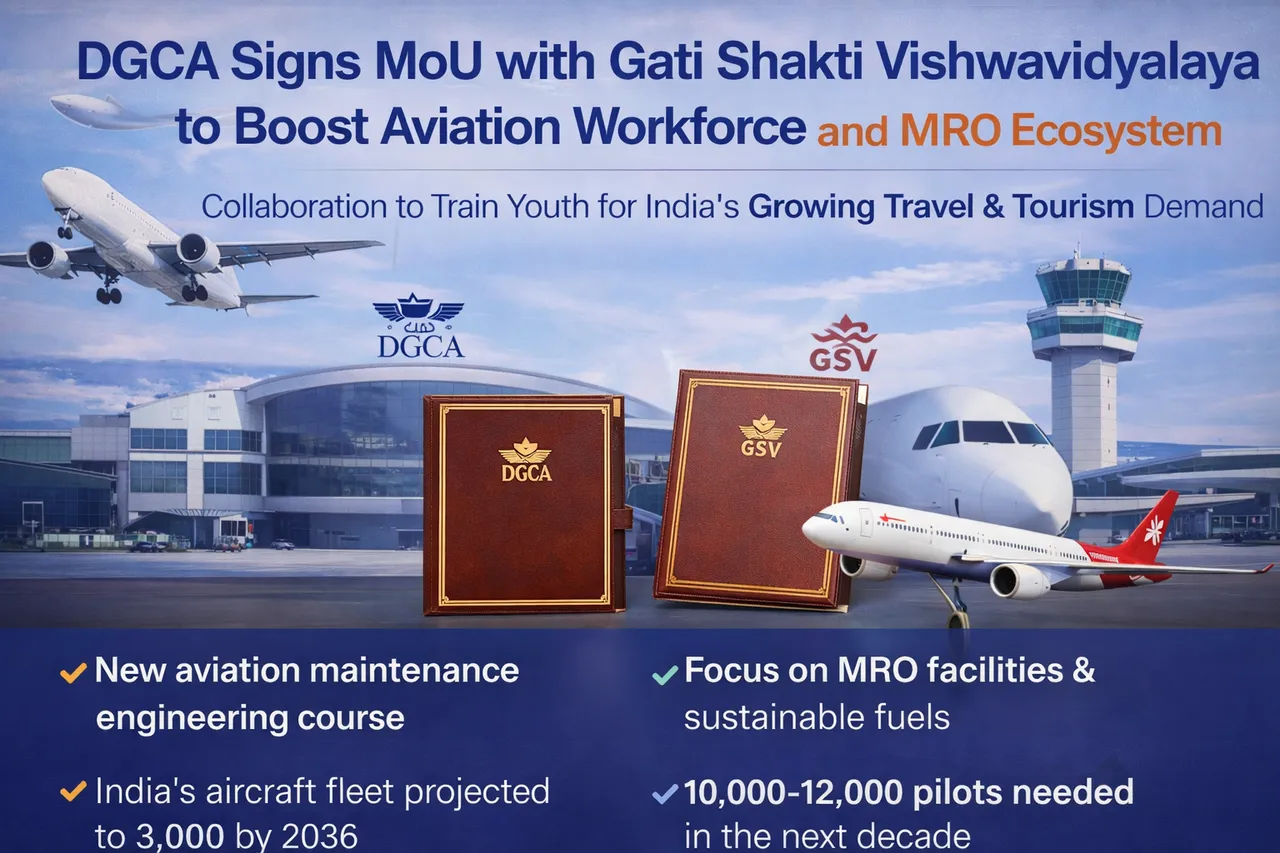
- ✈️ DGCA and Gati Shakti Vishwavidyalaya sign MoU for aviation training collaboration
- 🎓 New B.Sc. in Aviation Maintenance Engineering (AME) to launch in 2026-27
- 🛠️ Focus on MRO, aircraft manufacturing, and sustainable aviation fuels
- 📈 India’s aircraft fleet projected to reach 3,000 by 2036
- 👨✈️ Demand for 10,000–12,000 pilots in next decade
- 🌍 Partnership aims to position India as global aviation and MRO hub
News Report
In a move aimed at strengthening India’s aviation ecosystem and supporting the country’s rapidly growing travel and tourism sector, the Directorate General of Civil Aviation (DGCA) has signed a Memorandum of Understanding (MoU) with Gati Shakti Vishwavidyalaya (GSV) to enhance aviation education, training, and research.
The agreement focuses on building skilled manpower in aviation engineering, maintenance, and management—areas that are critical as India witnesses rising air travel demand driven by tourism, hospitality, and business travel.
Under the collaboration, a three-year undergraduate B.Sc. programme in Aviation Maintenance Engineering (AME) will be introduced from the academic year 2026-27. The course will integrate academic learning with industry requirements, regulatory compliance, and hands-on Maintenance, Repair and Overhaul (MRO) training.
Civil Aviation Minister Kinjarapu Rammohan Naidu highlighted that developing a strong aviation manufacturing ecosystem is key to India’s future growth. He noted that the number of MRO facilities in India has already increased from around 160 to more than 240 over the past five years.
The Minister also pointed out that India currently has around 1,700 aircraft on order, and the fleet could grow to nearly 3,000 aircraft by 2036. This expansion will significantly increase demand for trained professionals, including pilots, engineers, and ground support teams—critical for supporting tourism growth and regional connectivity.
The MoU also includes collaboration on research in Sustainable Aviation Fuels (SAF), aircraft parts manufacturing, and capacity building for aviation professionals. GSV will serve as an academic partner for curriculum innovation, industry-linked apprenticeships, and competency-based training.
This partnership is expected to strengthen India’s aviation workforce pipeline, improve MRO capabilities, and support the broader travel and hospitality ecosystem by ensuring reliable aviation infrastructure for growing passenger traffic.
With aviation playing a crucial role in tourism expansion, improved connectivity, and destination development, the initiative is aligned with India’s long-term vision of becoming a global aviation hub and supporting the Viksit Bharat 2047 mission.