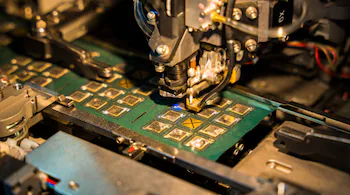
Uttar Pradesh is awaiting the IT ministry’s approval for two semiconductor projects submitted under the first phase of the India Semiconductor Mission (ISM), with the state having already granted conditional clearances to the proposals, a senior state government official said.
“There are two proposals with the Government of India. We have already given conditional approval from our side and are awaiting the Centre’s approval,” Himanshu Kaushik, Managing Director of the Uttar Pradesh Electronics Corporation Limited (UPECL), told Moneycontrol.
Kaushik did not specify whether the pending proposals are for fabrication units or semiconductor packaging facilities, saying he would have to verify those details.
The pending approvals come as the Ministry for Electronics and Information Technology (MeitY) prepares to roll out detailed guidelines for Semicon 2.0, approved by the Union Cabinet earlier this month.
Uttar Pradesh, which unveiled its semiconductor policy in 2024, is also preparing to review its incentive framework once the new guidelines are notified.
“We are waiting for the guidelines from the Government of India. Once we receive them, we will analyse Semicon 2.0 and, if required, come up with an amendment or a new semiconductor policy,” Kaushik said.
He added that the state intends to continue supplementing the Union government’s incentives.
Under the existing policy, Uttar Pradesh provides an additional subsidy equivalent to 50 per cent of the Centre’s fiscal support, besides offering a 75 per cent rebate on land cost, electricity duty exemption for 10 years and stamp duty concessions.
The remarks come after the Union Cabinet approved Semicon 2.0 with a lower central fiscal support for certain categories of semiconductor projects compared with the first phase.
While incentives for silicon fabs continue at up to 40 per cent of project cost, support for some packaging projects has been moderated.
“We will continue to do so, but we will study the new framework before deciding whether any substantial changes are needed,” he said.