The declaration condemns unilateral and secondary sanctions, apparently referring to US and European measures against Russia and Iran.
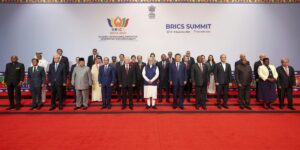
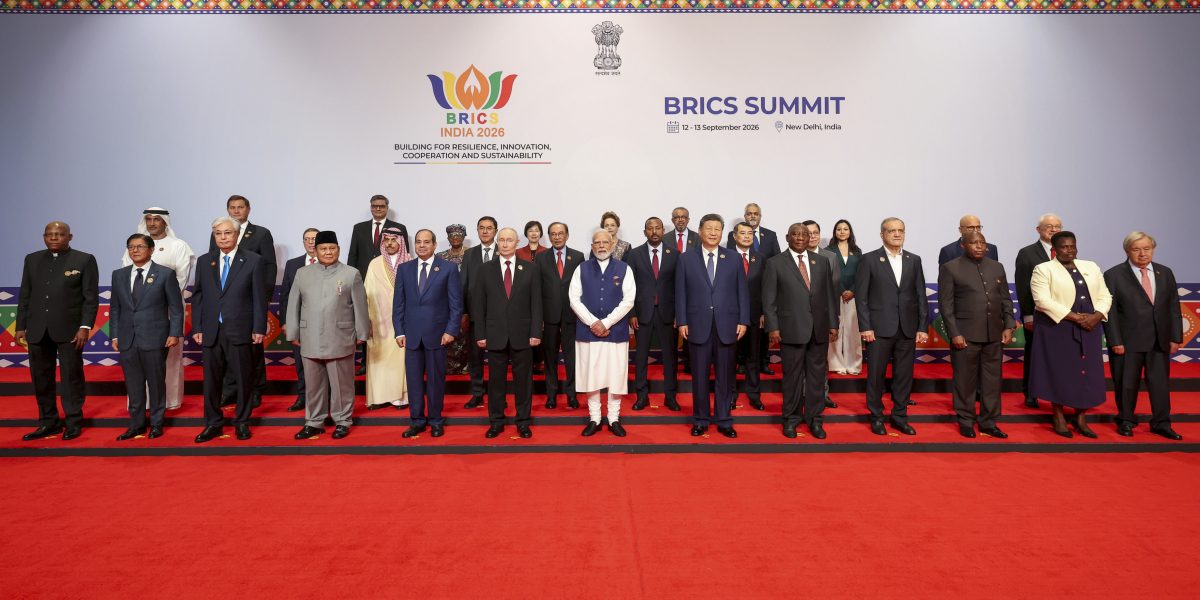
Prime Minister Narendra Modi with Russian President Vladimir Putin, Chinese President Xi Jinping, Kazakhstan President Kassym-Jomart Tokayev, Indonesian President Prabowo Subianto, Egyptian President Abdel Fattah el-Sisi, and other world leaders, poses for a group photograph at Bharat Mandapam on the second day of the BRICS Summit 2026, in New Delhi. Photo: PMO via PTI.
Trade is a major focus of the New Delhi Declaration, with 17 paragraphs addressing tariffs, sanctions, WTO reform, supply chains and intra-BRICS commerce. Although the declaration avoids naming countries, its targets are often clear. GTRI identifies the countries and policies behind these carefully worded criticisms.
The declaration supports a rules-based multilateral trading system and calls for the restoration of the WTO’s two-tier dispute-settlement mechanism [paragraph 20]. This appears to be aimed at the United States. Its unilateral tariffs have violated WTO rules, while its refusal to approve new Appellate Body members has paralysed the WTO’s appeals system. The Appellate Body has been unable to hear new appeals since December 2019 because the United States blocked the appointment of new members.
It also expresses concern over WTO-inconsistent trade restrictions, including indiscriminate tariff increases and “protectionism under the guise of environmental objectives” [paragraph 21]. The first reference appears to target recent US tariffs, while the second points to the European Union’s Carbon Border Adjustment Mechanism, or CBAM, which adds a carbon-related cost to imports.
BRICS also condemns unilateral economic and secondary sanctions that violate international law [paragraph 22]. This appears to refer to US and European sanctions against Russia and Iran, as well as threats of secondary sanctions against countries and companies that continue trading with them. For example, the United States has threatened penalties against firms and countries that purchase sanctioned Russian oil or conduct transactions with designated Iranian entities.
The declaration directly opposes “unilateral, punitive, discriminatory and protectionist measures” such as carbon border adjustment mechanisms [paragraph 108]. This is a clear criticism of the EU’s CBAM, although the European Union is not named. CBAM imposes an additional carbon-related cost on exports of products such as steel, aluminium, cement and fertilisers to the EU, potentially
weakening the competitiveness of developing-country exports.
On West Asia, the declaration calls for the smooth flow of global trade, supply chains and energy [paragraph 28]. This appears to urge both the United States and Iran to avoid actions that could disrupt shipping and energy supplies through the Strait of Hormuz. In the past six months, blockades, military strikes and attacks on commercial vessels in the Strait have disrupted oil, gas and other shipments, raising freight and insurance costs and pushing up global energy and raw-material prices.