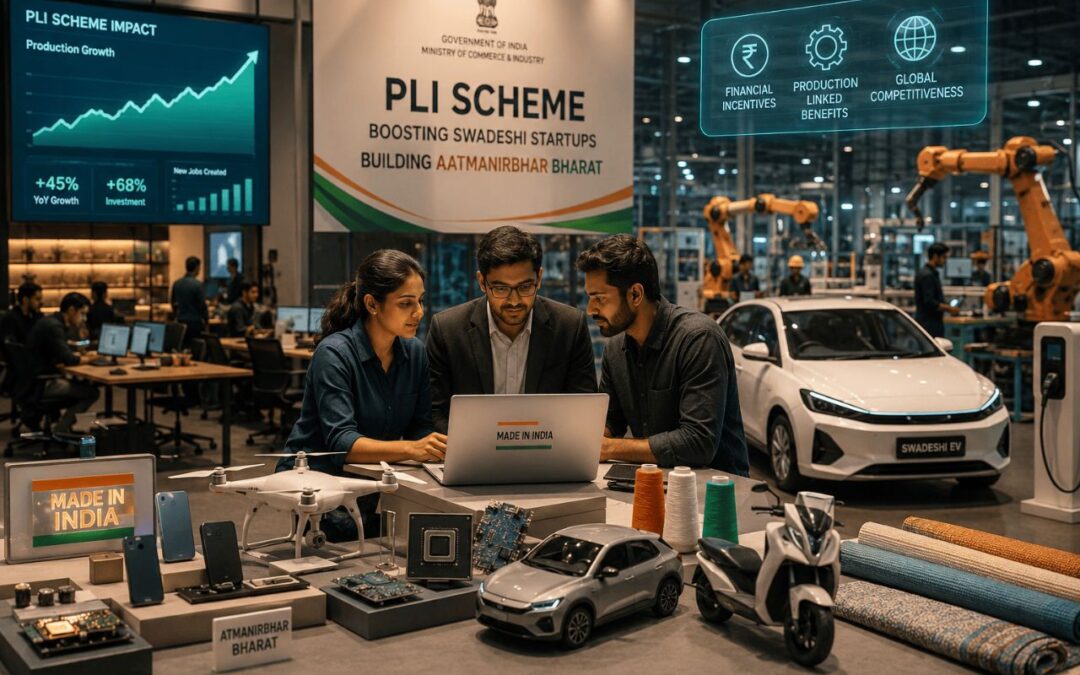
In recent years the importance of government-led industrial policies has grown as India aims to transform itself into a self manufacturing center. Of these, the Production Linked Incentive (PLI) Scheme has proven one of the most ambitious initiatives adopted by the country to boost investments, exports, and self-reliance in the list of critical sectors, while simultaneously strengthening the domestic manufacturing ecosystem.
What is the PLI Scheme?
A government scheme of Incentives for Production Linked (PLI) was launched in 2020 to promote manufacturing in India with a view to incentivizing companies based on incremental production and sales. The scheme is not a cash subsidy, but a subsidy to firms that expand their manufacturing levels beyond a base year. The present allocation of the scheme is nearly ₹1.97 lakh crore and is focused on 14 sectors such as electronics, pharmaceuticals, automobiles, telecom, textiles, food processing, solar PV modules, and drones. Incentives of between 4% and 6% of incremental sales are allowed to companies that fulfill investment and production requirements, subject to the different guidelines and requirements of the policies and according to the sector. The scheme works over a typical five year term dependent on the conditions and thresholds within each sector.
Objectives behind PLI
- Encourage local industries like electronics, telecom, automobiles, pharmaceuticals, and solar power.
- Decrease reliance on imports particularly on China for electronic components, APIs and telecom equipment.
- Foster large-scale investments, investment commitments under PLI which have surpassed ₹1.4 lakh crore by FY24.
- Expand exports and make India a world hub of manufacturing such as smartphones, electronics, automotive components etc.
- Create new factories, supply chains, logistics and ancillary industries and create jobs.
- Increase India’s contribution in the manufacturing sector and enhance competitiveness of the industries.
- Promote local production and value addition to support the Atmanirbhar Bharat and Make in India initiative.
- Encourage technology transfer and high-tech manufacturing through involvement of international companies.
How does the PLI scheme work?
The PLI scheme is based on the idea of incentivizing companies to boost their production in India. Incentives are offered based on “incremental sales” that is, companies only get the benefits if they produce and sell more than a set amount, or “base year”.
Basic Working Mechanism
- The company invests in manufacturing facilities in India.
- A base year for production/sales is fixed by the government.
- The company qualifies for incentives if its production/sales exceeds the base year.
- Incentives are offered as a percentage of incremental sales, typically 4%-6% of sales depending on the sector.
- Benefits are typically granted for 5 years according to the sector’s guidelines.
Sectors covered under PLI
| Sectors | Main focus |
|---|---|
| Electronics & mobile manufacturing | Increase production smartphone and components |
| Pharmaceuticals | Reduce dependence on imported APIs and bulk drugs |
| Telecom & networking products | Develop domestic telecom ecosystem |
| Automobile & auto components | Promote EVs and advanced automotive manufacturing |
| ACC Battery storage | Strengthen EV battery manufacturing |
| Solar PV Modules | Boost renewable energy manufacturing |
| Textiles | Promote MMF apparel and technical textiles |
| Food processing | Increase value-added food exports |
| Medical devices | Develop domestic medical equipment production |
| White goods | Manufacturing of ACs and LED components |
| Speciality steel | Improve domestic steel production capabilities |
| Drones &components | Support emerging drone industry |
| Semiconductor & display manufacturing | Develop chip manufacturing ecosystem |
| Pharmaceuticals & bulk drugs | Encourage local production of key drug ingredients |
Impact on Startups and MSMEs
- PLI provided manufacturing startups with growth opportunities across sectors such as EVs, drones, electronics, renewable energy, etc.
- The second benefit to the MSMEs is that of being a supplier and vendor to large PLI approved companies.
- Higher local production has supported the development of local supply chains and promoted the uptake of technology.
- Investors have been interested in the startups in EV batteries and electronics due to the manufacturing support by the government.
- In practice, however, due to the high investment requirements and the requirements for the schools, many of the small companies and start-ups cannot take part directly.
PLI and the “Swadeshi” vision
- This PLI scheme helps the government’s initiative of Atmanirbhar Bharat, which encourages companies to produce products in India rather than import goods.
- It is working towards the “Make in India” initiative and enhancing the capabilities of domestic manufacturing in various segments including electronics, telecom, pharmaceuticals, automobiles, solar energy, etc.
- The need for imported handsets has dwindled drastically with more than 99% of handsets sold in the country being made in India.
- The scheme promotes value addition and development of the Indian value chain in the country and makes the domestic industries compete in the international market.
- PLI also nurtures indigenous manufacturing through encouraging key sectors in the field of drones, telecom equipment, EV batteries, and solar modules, thus contributing to the country’s economic independence in the long run.
- Domestic manufacturing and export under PLI contributes to the progress of India towards becoming a manufacturing hub for domestic consumption and export economy.
Eligibility criteria for PLI
- The companies have to produce the products in India in order to avail benefits under the scheme.
- The eligibility conditions are different in every sector; and each ministry has separate investment and production targets.
- The minimum investment amount is different for various industries, ranging from approximately ₹10 crore for MSME industries to more than ₹100 crore for big industries.
- Incentives are only offered for incremental production or sales over the base year.
- Most PLI schemes are open to both domestic and foreign companies.
- Some sectors also mandate businesses to meet certain domestic value addition goals to encourage local sourcing and manufacturing.
- To keep enjoying the incentives, applicants have to comply with the timelines in terms of investment, production capacity and sales growth.
Benefits Provided Under PLI
- Financial incentives are offered to companies on the incremental sales, typically 4% – 6% per sector.
- Under the scheme, total investments have reached ₹1.46 lakh crore by FY24, which has enabled investments at a large scale.
- Fosters job creation; through factory expansion, supply chain, logistics and ancillary industries.
- Domestic production has led to an increase in exports, particularly in the fields of electronics and mobile manufacturing.
- The scheme encourages to improve manufacturing techniques and processes and involves participation of international companies.
- Local manufacturing decreases dependence on imports and enhances India’s manufacturing self-reliance.
Conclusion
The PLI scheme boosts the domestic manufacturing sector in India by fostering investments, production growth, exports, and self-reliance. This now only leads to manufacturing swadeshi goods but also creates jobs, attracts investments, and reduces dependence on imports. This scheme is now becoming an important step towards building a stronger and more self-reliant economy.