Green hydrogen is seen as the key to a climate-neutral future. But how is it produced and how does it get to where it is needed? In this compact, practical and easy-to-understand article, you will learn about the hydrogen value chain, from production to application.
What is green hydrogen?
Hydrogen is produced via electrolysis – a process in which water is split into hydrogen and oxygen using electricity. An important factor for producing green hydrogen is that the electricity used must come from renewable sources.
This is in contrast to, for example:
- Grey hydrogen produced from fossil fuels
- Pink hydrogen, which does not produce CO₂ as it uses nuclear energy, but does produce radioactive waste
- And blue hydrogen, in which CO₂ is separated and stored (carbon capture)
That means electrolysis is the first – and crucial – step in the hydrogen value chain.
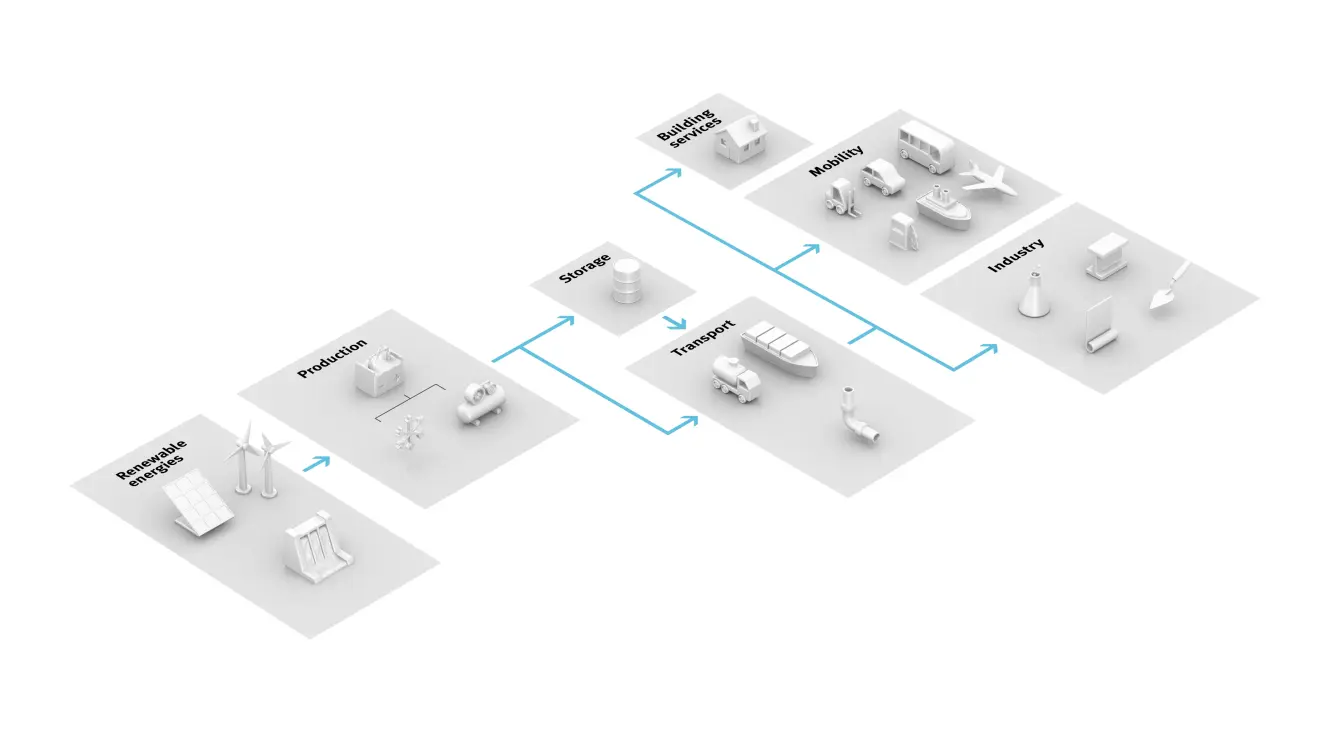
From molecule to mobility: the stations of hydrogen
Discover how automation can improve processes along the entire value chain.
1. Production
The starting point in the hydrogen value chain is electrolysis. Water is split into hydrogen and oxygen using electricity from renewable energy sources. Different electrolyser technologies are used depending on the framework conditions:
- PEM for flexible load change,
- Alkaline processes based on proven processes, or
- SOEC for maximum efficiency through high-temperature electrolysis
An automated controller ensures that the temperature, pressure and media flows are always within the optimum range, creating maximum efficiency and plant and system availability.
2. Hydrogen treatment
3. Compression and storage
4. Distribution and transport
5. Application
10 Common Mistakes to Avoid in Hydrogen Automation
Hydrogen automation is complex, and mistakes can be costly. This checklist helps you prevent risks and design safer, scalable systems. You’ll learn how to:
- Avoid the 10 most common errors
- Save time and reduce rework
- Strengthen safety and compliance
-
Why automation is key to scaling
Green hydrogen is only competitive if it can be produced and utilised safely, reliably and efficiently. This can be achieved when using automation solutions with valve terminals and modular controllers in combination with real-time diagnostic functions. For example, they can help to:
- Minimise downtimes
- Meet regulatory requirements (ATEX, SIL)
- Reduce system complexity
Festo – your partner along the entire value chain
Festo supports companies along the entire hydrogen value chain with industry-specific automation solutions. With our scalable systems, digital diagnostic functions and certified components, we help to make processes safe and future-proof, whether in electrolysis, gas treatment or mobile applications such as trailer control systems.