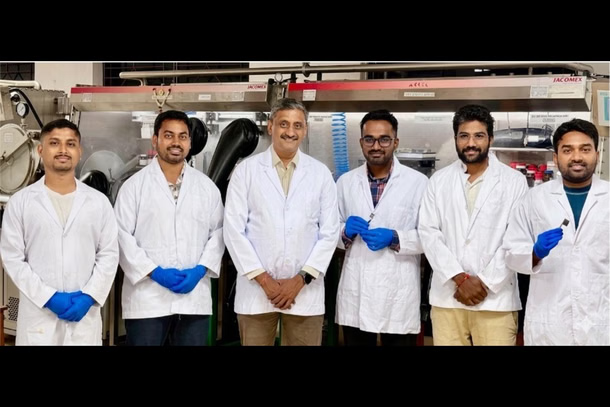
Researchers at IIT Guwahati have built a semiconductor platform from hybrid perovskite materials that can both convert sunlight into electricity at high efficiency and perform the memory functions needed for neuromorphic computing, Business Standard reported.
The work was led by Parameswar K Iyer, a professor in the Department of Chemistry and Centre for Nanotechnology, whose team set out to fix problems that have long held back perovskite-based devices in both solar and memory roles.
Although perovskites absorb light well and separate electrical charges efficiently, they tend to lose performance at material interfaces because of surface defects and energy mismatches, while uncontrolled ion movement disrupts switching in memory uses.
To tackle this, the team engineered ultrathin layers of two donor-acceptor organic molecules, each just 10 to 15 nanometres thick, placed between the perovskite and charge transport layers. These layers regulate charge flow and limit defects, boosting both efficiency and stability.
“The results have been remarkable. Solar cells incorporating the new interfacial engineering approach achieved a power conversion efficiency of 25.73 per cent, which is nearly one-quarter of the sunlight incident on the device converted directly into electricity. Such efficiency levels place the technology among the best-performing perovskite solar cells reported globally,” Parameswar K Iyer was quoted as saying by the Business Standard.
The same material was also turned into memristor devices showing stable, low-power switching and multiple memory states.