BRICS New Delhi Declaration 2026
A Major Milestone for PPP, Infrastructure Finance & Sustainable Development
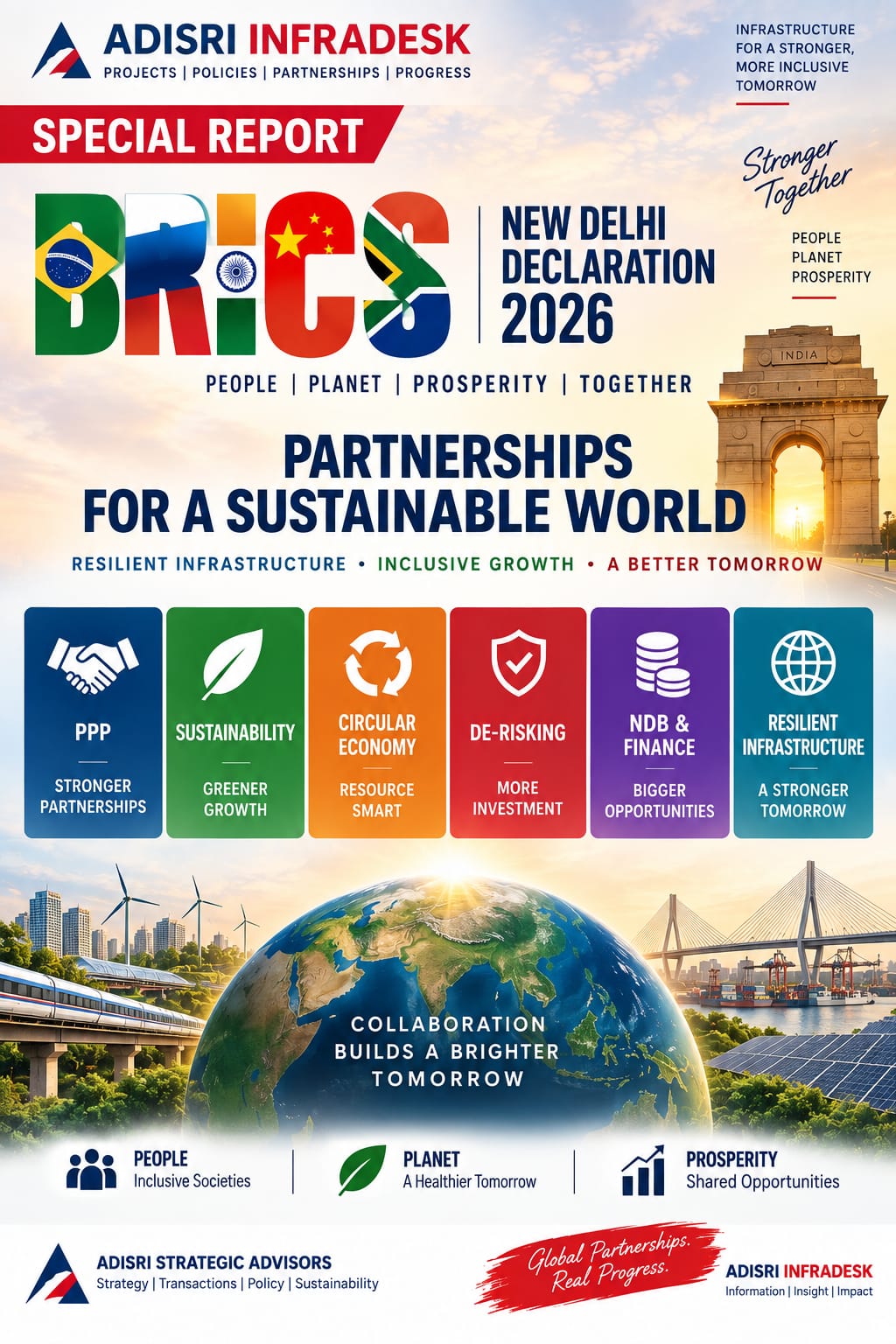
The adoption of the BRICS New Delhi Declaration under India’s Chairship is a significant milestone for infrastructure development across the Global South. The Declaration places Public-Private Partnerships (PPP), infrastructure finance, sustainability, climate resilience and circular economy at the centre of the development agenda and provides a strategic roadmap for mobilising private investment into quality infrastructure.
Key Highlights
1. PPP at the Centre of the BRICS Agenda
BRICS has formally welcomed the Technical Report on PPP Models, Modalities and De-risking Mechanisms, recognising the importance of stronger PPP ecosystems, better project preparation and balanced risk allocation to mobilise private capital.
2. Strong Focus on Project Bankability
The Declaration emphasises that sustainable infrastructure requires well-prepared, bankable projects supported by sound institutions, effective risk-sharing mechanisms and professional transaction structuring.
3. Multilateral Guarantees for Infrastructure
A major highlight is support for advancing multilateral guarantee mechanisms to improve project creditworthiness, reduce financing costs and attract long-term institutional investors into infrastructure.
4. Expanded Role of the New Development Bank (NDB)
The Declaration encourages the NDB to expand infrastructure financing, diversify funding sources, increase local-currency lending and mobilise greater private-sector participation.
5. Sustainable & Climate-Resilient Infrastructure
BRICS has reaffirmed its commitment to developing climate-resilient, low-carbon and sustainable infrastructure while strengthening disaster resilience and long-term infrastructure sustainability.
6. Circular Economy
The Declaration promotes resource efficiency, recycling, reuse, waste reduction, sustainable production and consumption, and circular business models to support long-term economic growth.
7. Climate Finance
Greater emphasis has been placed on mobilising climate finance, supporting adaptation and resilience, facilitating technology transfer and strengthening financial support for developing economies.
8. Clean Energy & Energy Transition
Priority areas include renewable energy, battery energy storage, smart grids, hydrogen, critical minerals and a just, orderly and inclusive energy transition.
9. Sustainable Transport & Connectivity
The Declaration supports stronger cooperation in railways, ports, logistics, civil aviation, digital infrastructure and cross-border connectivity to enhance regional integration and trade.
10. Digital Infrastructure & Innovation
Digital Public Infrastructure (DPI), Artificial Intelligence, innovation, science and technology have been recognised as important enablers of sustainable economic development.
Why It Matters for India
The Declaration closely aligns with India’s current infrastructure priorities, including:
Public-Private Partnerships (PPP)
Urban Challenge Fund (UCF)
Railway Hybrid Annuity Model (HAM)
Airport and Port PPPs
Renewable Energy & Battery Energy Storage Systems (BESS)
Smart Cities
Municipal Finance
Climate-Resilient Infrastructure
Circular Economy
Blended Finance and Institutional Capital Mobilisation
The overall message is clear: the future of infrastructure development will depend on well-prepared, bankable, sustainable and climate-resilient projects supported by innovative financing, effective risk allocation and strong public-private partnerships.
About the Author
Rajeev Chadha
PPPII Guru | Infrastructure Finance & PPP Expert
Director – Adisri Strategic Advisors (ASA)
Founder & Chief Editor – Adisri Infradesk
38+ Years of Experience | 1,800+ Infrastructure Projects | 350+ PPP Projects | 250+ Transaction Advisory Assignments
📱 Mobile / WhatsApp: +91 87002 20087
📧 Email: officeofrajeevchadha@gmail.com
📧 Email: rajeev@adisristrategic.com
🌐 Website: www.adisriinfradesk.com